Comprehensive guide to pallet receiving, storage, handling, racking, loading, shipping, and recovery. Best practices from MHI, OSHA, NIOSH, NWPCA, and 15+ other authorities.
Introduction
Industrial-scale The Complete Guide to Pallet Operations and Best Practices for national, United States customers requires more than just stock on hand - it requires consistent dimensional tolerances, batch-quality records, and documentation that satisfies SOX, FDA, USDA, ISO 9001, and similar audit frameworks. United States Pallets ships every The Complete Guide to Pallet Operations and Best Practices load with the documentation packet pre-attached electronically, no dock-side delays.
United States businesses handling commercial pallet supply for national-area operations need a supplier that delivers consistent grade quality, dimensional tolerances tighter than industry standard, and audit-ready documentation. United States Pallets The Complete Guide to Pallet Operations and Best Practices for national meets each of those bars, with quote response under 2 business hours and net-30 credit terms after the first 1-3 prepaid loads.
Pallet Operations Overview
Pallet operations span the full warehouse and distribution lifecycle: receiving, putaway, storage, picking, replenishment, loading, shipping, and recovery. Per Material Handling Institute benchmarks, leading operations achieve damage rates below 0.5%, on-time delivery above 98%, and ergonomic injury rates below industry average.
Receiving and Inspection
Receiving inspection catches approximately 60% of all pallet defects per NWPCA industry data. A complete receiving inspection covers visual, structural, and documentation elements. Defects flagged at receiving cost 5-10x less to address than defects discovered after putaway.
Storage Best Practices
Storage type drives capacity, throughput, and access. Selective racking offers maximum SKU access. Drive-in racking maximizes density. Push-back racking balances both. Floor stacking minimizes equipment cost. Rack Manufacturers Institute ANSI MH16.1 governs rack design.
Handling Equipment
Pallet handling equipment ranges from manual pallet jacks to powered walkies, riders, counterbalance forklifts, reach trucks, narrow-aisle forklifts, and AGV/AMR systems. OSHA 29 CFR 1910.178 requires operator certification for powered equipment.
Ergonomics
Per NIOSH Lifting Equation, manual pallet handling above 100 pallets/shift warrants powered handling. Conversion to powered handling reduces ergonomic injury rates by 50-70% over a multi-year horizon.
Loading and Cube Optimization
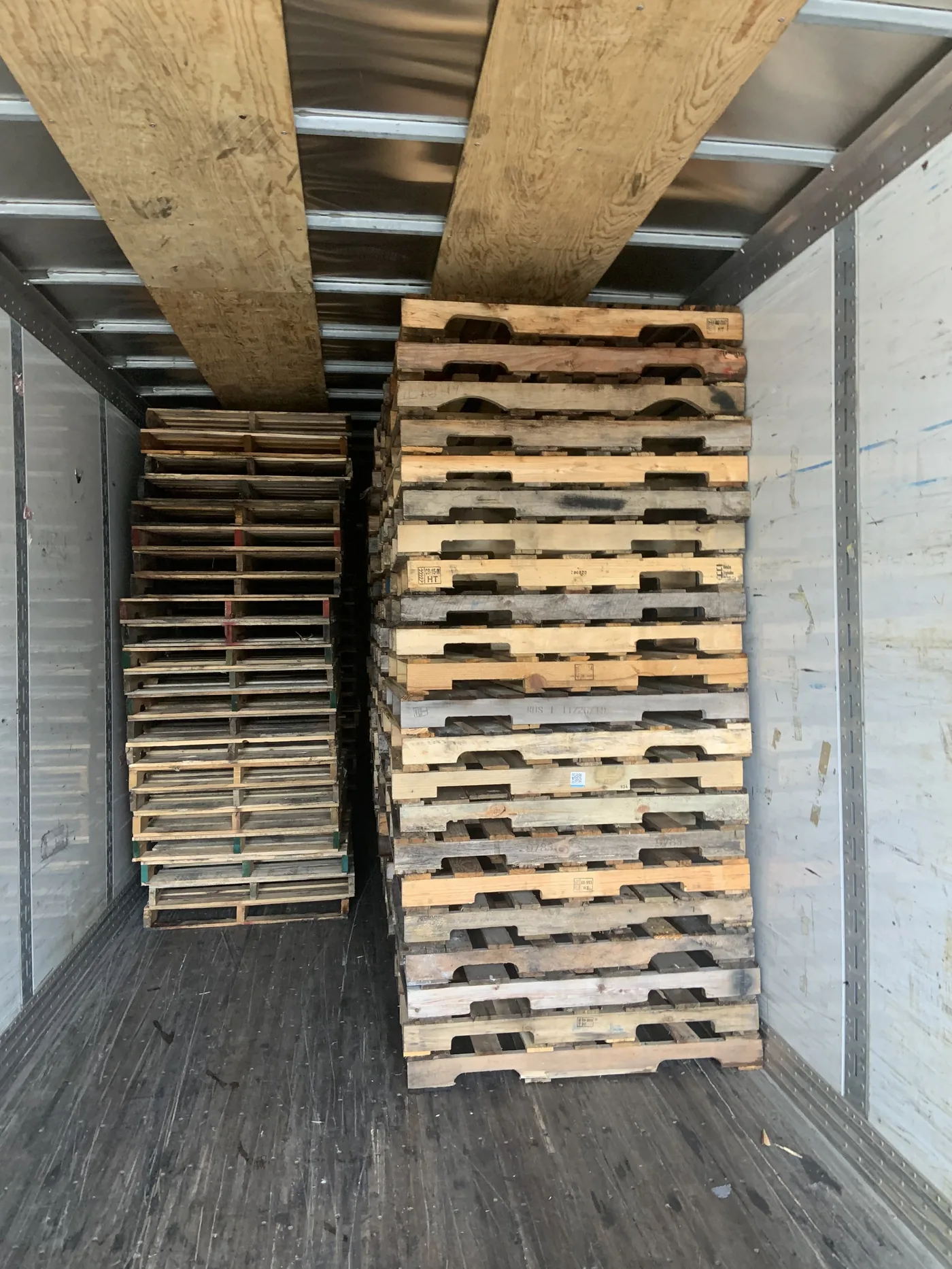
Trailer cube optimization typically achieves 80-95% utilization with 53' dry vans loaded with 48x40 GMA pallets. Stack height (typically 2 high), pallet orientation, and weight distribution all affect cube vs weight-out limits.
Cross-Docking
Cross-docking moves pallets from inbound to outbound dock without intermediate storage. Effective cross-docking requires: matched inbound/outbound timing, sufficient dock door capacity, and well-documented unit-load identity (typically GS1 SSCC labels).
Pallet Recovery and Buy-Back
Pallet recovery via buy-back programs typically returns 18-25% of original purchase cost. Standing pickup programs coordinated with new-pallet delivery (backhaul logistics) approach zero per-pallet freight cost.
In-Depth Resources Across This Topic
- Receiving Inspection
- Storage Best Practices
- Handling Ergonomics
- Stacking OSHA Compliance
- Pallet Jack Types
- Conveyor Handling
- AMR Compatibility
- ASRS Compatibility
- Cross-Docking Strategy
- Cube Optimization
- Strapping and Banding
- Stretch Wrap
- Dock Design
- Loading Best Practices
- Double-Stack Loading
- Reefer Loading
- Dry Van Loading
- Flatbed Loading
- Warehouse Flow Optimization
- Grade Inspection
Authoritative Sources Cited Throughout This Guide
- Material Handling Institute (MHI): the largest US trade association for material handling, logistics, and supply chain technologies.
- Occupational Safety and Health Administration (OSHA): the US federal agency whose 29 CFR 1910 standards govern warehouse pallet handling and storage.
- National Institute for Occupational Safety and Health (NIOSH): the federal research institute publishing the NIOSH Lifting Equation and pallet handling ergonomic guidance.
- National Wooden Pallet & Container Association (NWPCA): the US trade association representing wood pallet manufacturers, recyclers, and component producers, founded in 1947.
- Rack Manufacturers Institute (RMI): the MHI subsidiary that publishes ANSI MH16.1 pallet rack design and load capacity standards.
- ASTM International (ASTM): the global standards body that publishes ASTM D1185 (Standard Test Methods for Pallets and Related Structures Employed in Materials Handling and Shipping).
- FDA Food Safety Modernization Act (FSMA): the federal food safety law that governs pallet sanitation, traceability, and the Sanitary Transportation of Human and Animal Food rule.
- US Environmental Protection Agency (EPA): the federal agency that regulates pallet recycling and the Sustainable Materials Management hierarchy.
- American Trucking Associations (ATA): the largest national trade association for the US trucking industry.
- Transportation Intermediaries Association (TIA): the trade association representing US freight intermediaries and 3PL operators.