Industry-tuned automotive & oem tier-1 pallets for aerospace & defense buyers across Florida.
Get a Price →Automotive & OEM Tier-1 Pallets for Aerospace & Defense suppliers serving Florida businesses range from regional yards with limited inventory to national networks with deep multi-grade stock. United States Pallets sits in the second category, structured specifically for high-volume B2B operations - 50+ pallets per order minimum, scheduled programs for 500+/week accounts, and dimensional consistency tight enough for AGV-equipped warehouses.
Pallet demand in Florida, Florida is shaped by the local economy and the regional supply chain - distribution, manufacturing, and food/beverage operations all consume pallets at predictable cadences. United States Pallets aligns our Automotive & OEM Tier-1 Pallets for Aerospace & Defense delivery rhythm to those operations, with same-day rush options when production schedules tighten and standing-order programs for predictable weekly volume.
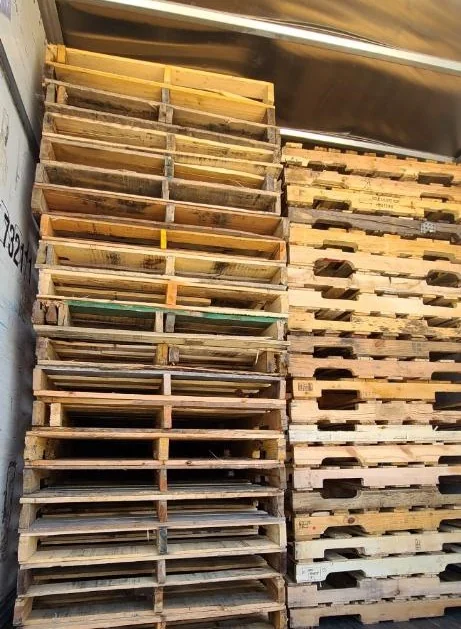
50 pallets per order minimum on buy-side. Sell-side (buyback) minimum is 250 pallets per single-size load. Volume tiers kick in automatically as cumulative monthly volume increases - 500+/week accounts qualify for standing-order programs with reserved delivery slots.
Yes. We buy back used pallets from Florida collectors, recyclers, and warehouses - 250-pallet minimum per load, single-size only (no mixed-size loads). Fast ACH payment, typically same-day or net-7 depending on volume. Pickup arranged on standard outbound delivery routes.
Yes. We deliver to every commercial address in Florida, with same-day shipping standard in our Southeast/Mid-Atlantic core and scheduled weekly delivery elsewhere. Florida-area accounts are typical - submit a quote with your dock location and we route accordingly.
Local Florida suppliers offer geographic proximity. United States Pallets offers nationwide sourcing depth, multi-grade inventory always in stock, sub-2-business-hour quote response, audit-ready documentation, and standing-order automation that local yards typically don\'t match.
BOL, packing list, grade certifications standard. Heat-treated loads add IPPC stamps and ISPM-15 documentation. Pharma-grade loads add batch records. Food-grade loads add FSMA Sanitary Transportation Rule certifications. All documentation ships electronically before delivery.
Response under 2 business hours.
All pallets stamped IPPC HT for ISPM-15 export compliance to 180+ countries; documentation includes treatment temperature logs and the registered facility number.
Hurricane preparedness regulations in Miami-Dade and Broward counties require commercial pallet inventory to be either secured (banded + tarped) or relocated above 12 feet by June 1 storm-season opening; our staging team manages compliance for recurring customers.
Florida DOACS regulations require ISPM-15 documentation on every export load originating from PortMiami, Port Everglades, JAXPORT, and Port Tampa Bay; we maintain on-call certification staff at all four ports.
Block pallets (four-way entry) use nine 4-inch hardwood blocks with continuous-face top deck; ideal for ASRS (automated storage and retrieval) and AGV (automated guided vehicle) operations where stringer interruptions cause read-failures.
Lumber spec for new GMA stock: mixed hardwood (oak, maple, ash, hickory) with minimum 600 SG (specific gravity); kiln dried to <19% moisture; visible defects limited to wane on outer 1/3 of deck board only.
Flatbed delivery handles oversized loads or pallets with overhanging product; tarping included; preferred for export crates and bulk lumber shipments.
Marine industry suppliers (Fort Lauderdale, Stuart, Miami) use exterior-rated pallets that resist saltwater corrosion; treated lumber stock available; preferred for boat-component freight to Bahamas and Caribbean.
Buyback pricing for returned pallets: $3-5 per Grade A unit; $1-2 per Grade B; minimum 50-pallet pickup; integrated with our recycling stream for sustainability accounting.
Lumber sourcing prioritizes regional Southeast US hardwood mills (FL, AL, GA, MS); reduces transport carbon vs Pacific Northwest stock; supports regional logging economies.