Industry-tuned block pallets - four-way entry for bakery & confectionery buyers across Georgia.
Get a Price →Block Pallets - Four-Way Entry for Bakery & Confectionery in Georgia, Georgia is foundational infrastructure for any commercial operation moving goods through Georgia's industrial supply chain. United States Pallets (Georgia customers reach us at our national dispatch line) provides Block Pallets - Four-Way Entry for Bakery & Confectionery on a 50-pallet minimum with same-day shipping in our Southeast/Mid-Atlantic core and scheduled weekly delivery to Georgia elsewhere.
Block Pallets - Four-Way Entry for Bakery & Confectionery suppliers serving Georgia businesses range from regional yards with limited inventory to national networks with deep multi-grade stock. United States Pallets sits in the second category, structured specifically for high-volume B2B operations - 50+ pallets per order minimum, scheduled programs for 500+/week accounts, and dimensional consistency tight enough for AGV-equipped warehouses.
Yes. Backhaul logistics are coordinated on outbound delivery routes - empty or non-spec pallets get picked up on the return leg of new pallet deliveries. Per-pallet freight cost on the backhaul approaches zero for accounts running both new-pallet purchase + buyback simultaneously.
50 pallets per order minimum on buy-side. Sell-side (buyback) minimum is 250 pallets per single-size load. Volume tiers kick in automatically as cumulative monthly volume increases - 500+/week accounts qualify for standing-order programs with reserved delivery slots.
Yes. Standing-order programs for Georgia operations running 500+ pallets/week lock in tiered pricing, reserve delivery slots, and run on autopilot in the background. Custom contract terms available for accounts running 2,000+/week.
Same-day shipping in our Southeast/Mid-Atlantic core (FL, GA, AL, TN, MS, SC, NC, KY, VA) and scheduled weekly delivery elsewhere. Express options available for Georgia rush orders. Quote response under 2 business hours, dispatch within hours of order confirmation.
Yes, with ISPM-15 heat-treated pallets carrying IPPC stamps and full ISPM-15 documentation. Required for international shipments to all WTO member countries. Common for Georgia customers with port access via Georgia\'s major export gateways.
Response under 2 business hours.
Kiln-dried hardwood meets NWPCA Uniform Standard for Wood Pallets; moisture content verified <19% at dispatch, blade-cut deck boards, no visible bark.
Atlanta Hartsfield-Jackson air-cargo operations at the world's busiest passenger airport require flame-retardant treated pallets for in-cabin loads; we maintain Class A flame-rated stock for forwarder accounts.
Georgia Department of Agriculture phytosanitary rules require ISPM-15 documentation on every export load from Savannah and Brunswick ports; we coordinate with Georgia Ports Authority inspectors for certified loads through pier gate.
ISPM-15 export pallets receive heat treatment to 56C core temperature for 30 minutes; stamping shows IPPC logo, country code 'US', registered facility number, and treatment code 'HT'.
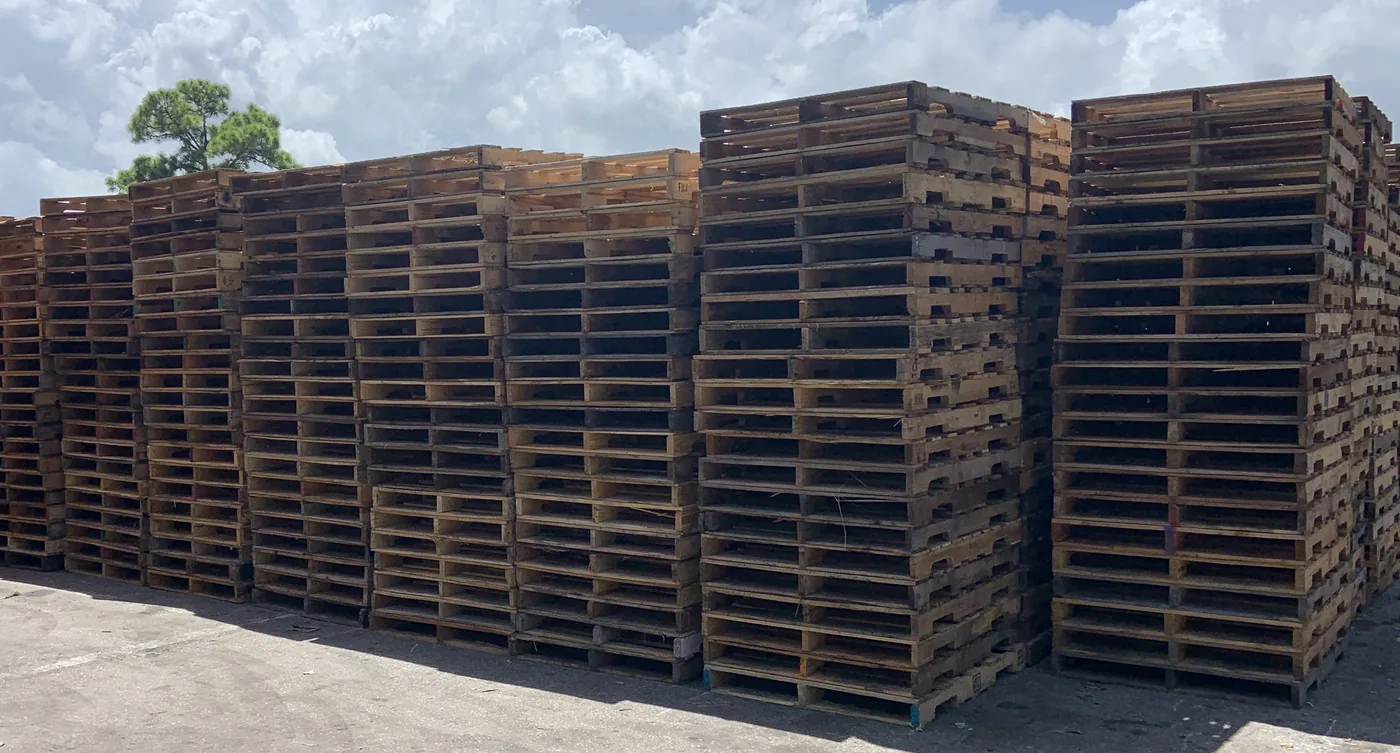
Block pallets (four-way entry) use nine 4-inch hardwood blocks with continuous-face top deck; ideal for ASRS (automated storage and retrieval) and AGV (automated guided vehicle) operations where stringer interruptions cause read-failures.
Dry-van loads handle weather-sensitive pallet stock and food-grade freight; sealed loads with bill-of-lading documentation; supports DOT-required commercial routing.
Marine industry suppliers (Fort Lauderdale, Stuart, Miami) use exterior-rated pallets that resist saltwater corrosion; treated lumber stock available; preferred for boat-component freight to Bahamas and Caribbean.
Volume pricing kicks in at 100 pallets, 500 pallets, and 2,000 pallets per month; sustained standing orders lock pricing for 12 months; spot orders subject to current lumber market pricing.
Sustainability reports provided quarterly to standing-order customers; documents pallets recycled, lumber diverted from landfill, and CO2-equivalent savings vs new-only sourcing.