Industry-tuned block pallets - four-way entry for distribution & warehousing buyers across Wyoming.
Get a Price →When Wyoming, Wyoming operations need Block Pallets - Four-Way Entry for Distribution & Warehousing at scale, the supplier shortlist comes down to three things: inventory depth, delivery reliability, and documentation. United States Pallets engineers our Block Pallets - Four-Way Entry for Distribution & Warehousing program to win on all three - new GMA stock plus recycled Grade A and B always available, scheduled weekly delivery, and BOL/IPPC/grade certifications electronic before each load arrives.
Industrial-scale Block Pallets - Four-Way Entry for Distribution & Warehousing for Wyoming, Wyoming customers requires more than just stock on hand - it requires consistent dimensional tolerances, batch-quality records, and documentation that satisfies SOX, FDA, USDA, ISO 9001, and similar audit frameworks. United States Pallets ships every Block Pallets - Four-Way Entry for Distribution & Warehousing load with the documentation packet pre-attached electronically, no dock-side delays.
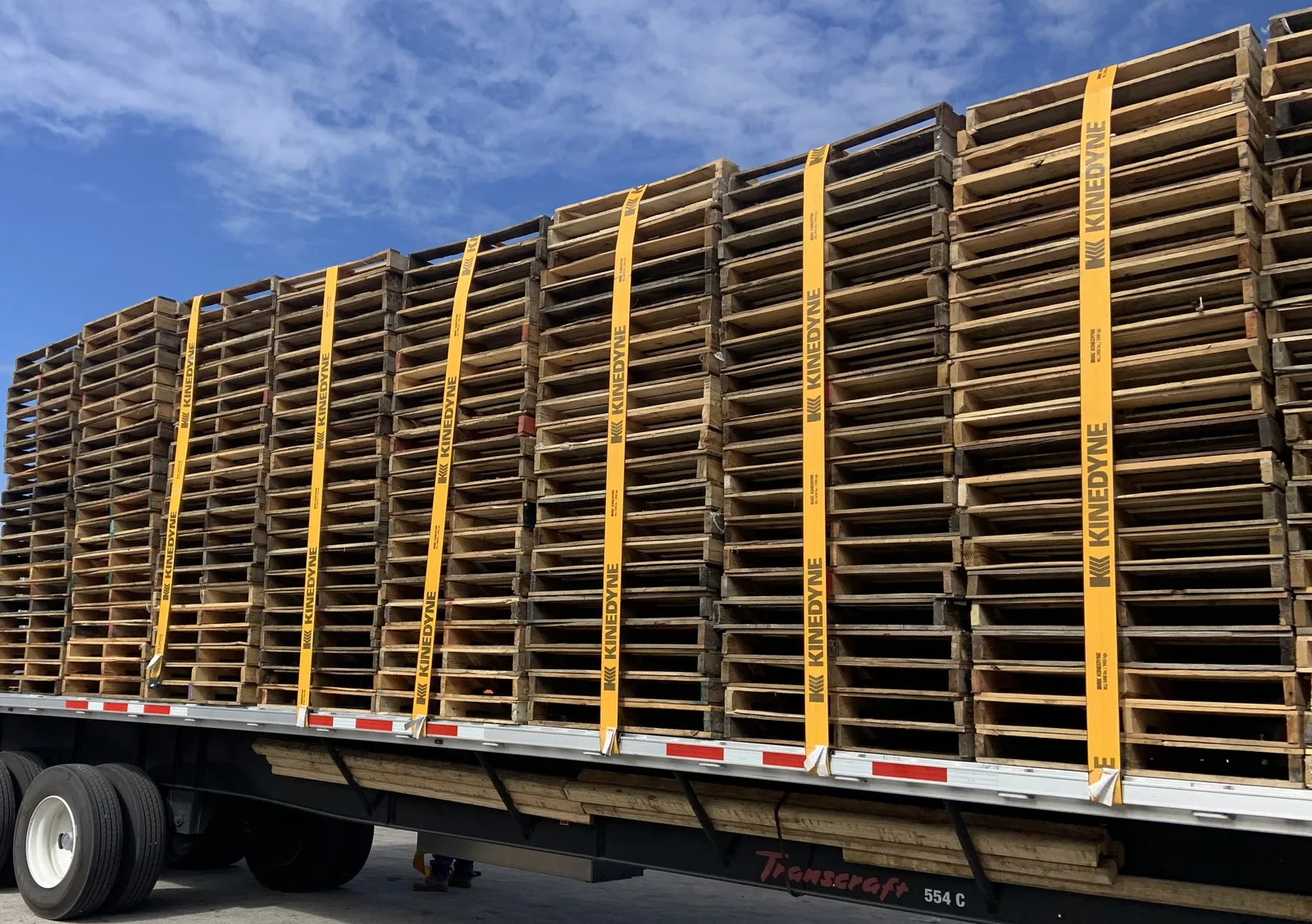
Yes. Backhaul logistics are coordinated on outbound delivery routes - empty or non-spec pallets get picked up on the return leg of new pallet deliveries. Per-pallet freight cost on the backhaul approaches zero for accounts running both new-pallet purchase + buyback simultaneously.
Local Wyoming suppliers offer geographic proximity. United States Pallets offers nationwide sourcing depth, multi-grade inventory always in stock, sub-2-business-hour quote response, audit-ready documentation, and standing-order automation that local yards typically don\'t match.
Yes. We buy back used pallets from Wyoming collectors, recyclers, and warehouses - 250-pallet minimum per load, single-size only (no mixed-size loads). Fast ACH payment, typically same-day or net-7 depending on volume. Pickup arranged on standard outbound delivery routes.
50 pallets per order minimum on buy-side. Sell-side (buyback) minimum is 250 pallets per single-size load. Volume tiers kick in automatically as cumulative monthly volume increases - 500+/week accounts qualify for standing-order programs with reserved delivery slots.
BOL, packing list, grade certifications standard. Heat-treated loads add IPPC stamps and ISPM-15 documentation. Pharma-grade loads add batch records. Food-grade loads add FSMA Sanitary Transportation Rule certifications. All documentation ships electronically before delivery.
Response under 2 business hours.
GMA 48x40 four-way stringer construction conforms to the National Wooden Pallet & Container Association (NWPCA) 2014 Uniform Standard; deck board configuration 7-board top, 5-board bottom.
Dry-van loads handle weather-sensitive pallet stock and food-grade freight; sealed loads with bill-of-lading documentation; supports DOT-required commercial routing.
Standing-order programs schedule a recurring weekly truckload (or partial) for the same delivery window; price-locked for 12 months; preferred for 3PL warehouse refill cycles.
Recycled-Grade B pallets meet structural spec but may have up to 2 replaced deck boards; suitable for industrial loads outside food/pharma; price point 30-40% below new GMA.
Deck board edge type defaults to chamfered for forklift safety; square-edge available on request for ASRS compatibility; rounded-edge banding tracks available for high-throughput line-side delivery.
Drop-trailer programs maintain a customer-dedicated 53-foot trailer on-site; we swap full-for-empty on a scheduled 24/48/72-hour rotation; preferred for high-throughput dock operations.
Pharmaceutical distribution centers in Hillsborough and Orange counties require GDP-validated cold-chain pallets; we supply plastic-construction reusable pallets that wash down for sterile transfer applications.
Custom pallet pricing depends on lumber spec, build complexity, and quantity: small runs (50-200 units) typically $35-55 per unit; large runs (500+ units) drop to $22-32 per unit; quotes returned in <2 hours.
Lumber sourcing prioritizes regional Southeast US hardwood mills (FL, AL, GA, MS); reduces transport carbon vs Pacific Northwest stock; supports regional logging economies.