Industry-tuned block pallets - four-way entry for hospitality & foodservice buyers across Georgia.
Get a Price →Whether you're operating a single Georgia warehouse or a multi-site network across Georgia, the Block Pallets - Four-Way Entry for Hospitality & Foodservice requirements are the same: consistent grade, on-time delivery, accurate count, and clean paperwork. United States Pallets built our Block Pallets - Four-Way Entry for Hospitality & Foodservice program around exactly that profile of customer.
Pallet demand in Georgia, Georgia is shaped by the local economy and the regional supply chain - distribution, manufacturing, and food/beverage operations all consume pallets at predictable cadences. United States Pallets aligns our Block Pallets - Four-Way Entry for Hospitality & Foodservice delivery rhythm to those operations, with same-day rush options when production schedules tighten and standing-order programs for predictable weekly volume.
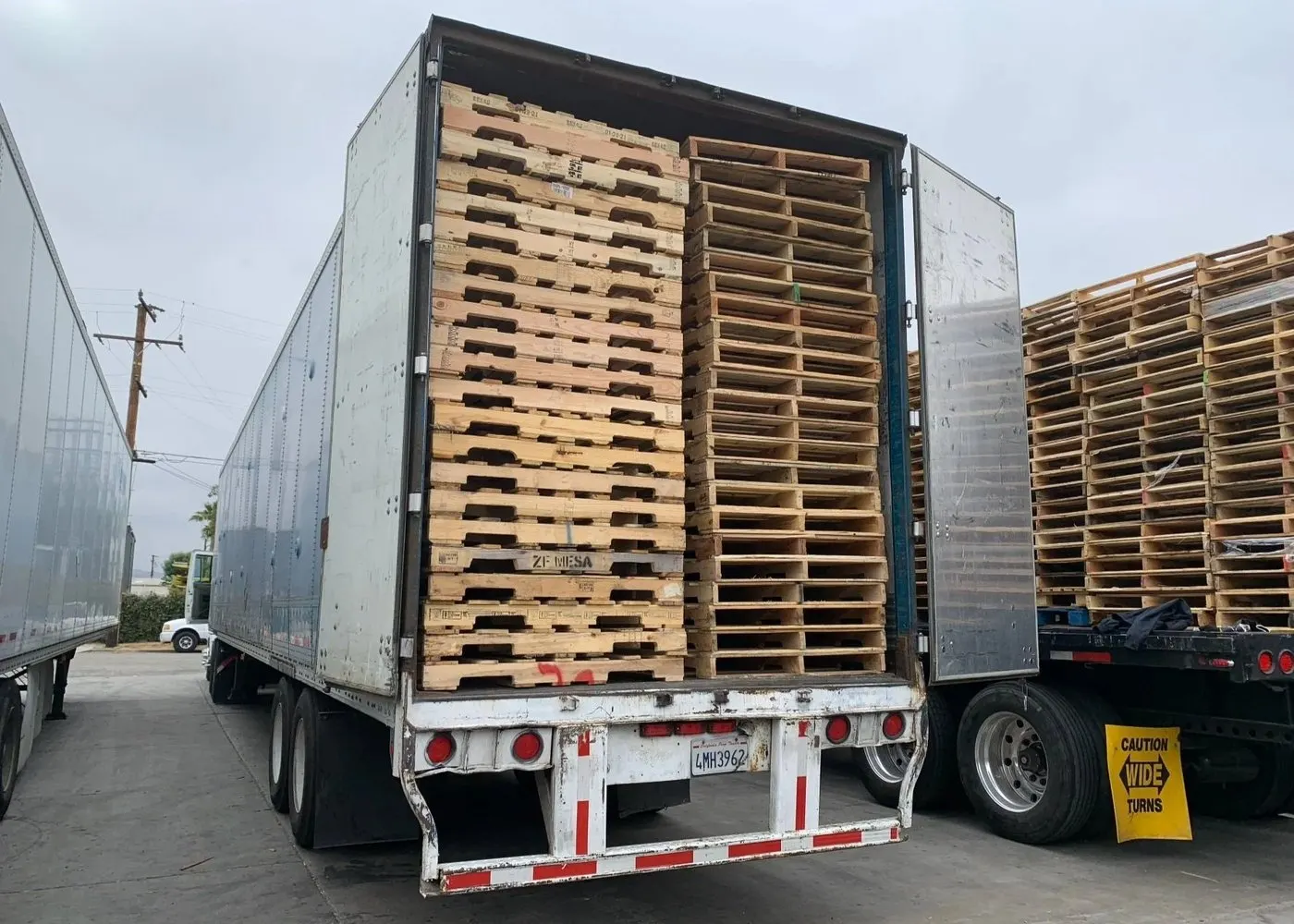
Same-day shipping in our Southeast/Mid-Atlantic core (FL, GA, AL, TN, MS, SC, NC, KY, VA) and scheduled weekly delivery elsewhere. Express options available for Georgia rush orders. Quote response under 2 business hours, dispatch within hours of order confirmation.
Local Georgia suppliers offer geographic proximity. United States Pallets offers nationwide sourcing depth, multi-grade inventory always in stock, sub-2-business-hour quote response, audit-ready documentation, and standing-order automation that local yards typically don\'t match.
Yes. Backhaul logistics are coordinated on outbound delivery routes - empty or non-spec pallets get picked up on the return leg of new pallet deliveries. Per-pallet freight cost on the backhaul approaches zero for accounts running both new-pallet purchase + buyback simultaneously.
BOL, packing list, grade certifications standard. Heat-treated loads add IPPC stamps and ISPM-15 documentation. Pharma-grade loads add batch records. Food-grade loads add FSMA Sanitary Transportation Rule certifications. All documentation ships electronically before delivery.
Yes. We buy back used pallets from Georgia collectors, recyclers, and warehouses - 250-pallet minimum per load, single-size only (no mixed-size loads). Fast ACH payment, typically same-day or net-7 depending on volume. Pickup arranged on standard outbound delivery routes.
Response under 2 business hours.
All pallets stamped IPPC HT for ISPM-15 export compliance to 180+ countries; documentation includes treatment temperature logs and the registered facility number.
Georgia poultry packers in Gainesville, Athens, and South Georgia require FDA 21 CFR 178.3520 indirect food additive compliant pallets; our food-grade stock serves Tyson, Pilgrim's, and Wayne Farms supply chains.
Georgia Department of Transportation oversize-load permits restrict pallet shipments above 80,000 lb GVW; our DOT-permitted carriers handle Atlanta-area, Macon-corridor, and coastal Savannah-Brunswick routing.
Custom 42x42 pallet builds use 7/8 inch deck boards for telecommunications-equipment loads; nail-pattern density doubled to handle 5,000 lb static load; runner spacing optimized for 4,000 lb-capacity narrow-aisle reach trucks.
Block pallets (four-way entry) use nine 4-inch hardwood blocks with continuous-face top deck; ideal for ASRS (automated storage and retrieval) and AGV (automated guided vehicle) operations where stringer interruptions cause read-failures.
Buyback programs pay current market rate for returned pallets in Grade A condition; minimum 50 pallets per pickup; integrated with our recycling stream for sustainability reporting.
Construction supply yards (Home Depot, Lowe's distribution) move lumber and hardware on 48x40 GMA in 5,000+ pallet weekly cycles; we supply both the inbound load pallets and the return-stream recycled stock.
Pricing structure: new 48x40 GMA stock ranges $14-18 per pallet in 500+ lot pricing; recycled Grade A runs $7-10 per pallet; recycled Grade B at $5-7; custom builds priced per spec on a quote basis.
Lumber sourcing prioritizes regional Southeast US hardwood mills (FL, AL, GA, MS); reduces transport carbon vs Pacific Northwest stock; supports regional logging economies.