Industry-tuned block pallets - four-way entry for hvac & plumbing supply buyers across Illinois.
Get a Price →When Illinois, Illinois operations need Block Pallets - Four-Way Entry for HVAC & Plumbing Supply at scale, the supplier shortlist comes down to three things: inventory depth, delivery reliability, and documentation. United States Pallets engineers our Block Pallets - Four-Way Entry for HVAC & Plumbing Supply program to win on all three - new GMA stock plus recycled Grade A and B always available, scheduled weekly delivery, and BOL/IPPC/grade certifications electronic before each load arrives.
Block Pallets - Four-Way Entry for HVAC & Plumbing Supply in Illinois, Illinois is foundational infrastructure for any commercial operation moving goods through Illinois's industrial supply chain. United States Pallets (Illinois customers reach us at our national dispatch line) provides Block Pallets - Four-Way Entry for HVAC & Plumbing Supply on a 50-pallet minimum with same-day shipping in our Southeast/Mid-Atlantic core and scheduled weekly delivery to Illinois elsewhere.
BOL, packing list, grade certifications standard. Heat-treated loads add IPPC stamps and ISPM-15 documentation. Pharma-grade loads add batch records. Food-grade loads add FSMA Sanitary Transportation Rule certifications. All documentation ships electronically before delivery.
Yes. Backhaul logistics are coordinated on outbound delivery routes - empty or non-spec pallets get picked up on the return leg of new pallet deliveries. Per-pallet freight cost on the backhaul approaches zero for accounts running both new-pallet purchase + buyback simultaneously.
Same-day shipping in our Southeast/Mid-Atlantic core (FL, GA, AL, TN, MS, SC, NC, KY, VA) and scheduled weekly delivery elsewhere. Express options available for Illinois rush orders. Quote response under 2 business hours, dispatch within hours of order confirmation.
Yes, with ISPM-15 heat-treated pallets carrying IPPC stamps and full ISPM-15 documentation. Required for international shipments to all WTO member countries. Common for Illinois customers with port access via Illinois\'s major export gateways.
Yes. Standing-order programs for Illinois operations running 500+ pallets/week lock in tiered pricing, reserve delivery slots, and run on autopilot in the background. Custom contract terms available for accounts running 2,000+/week.
Response under 2 business hours.
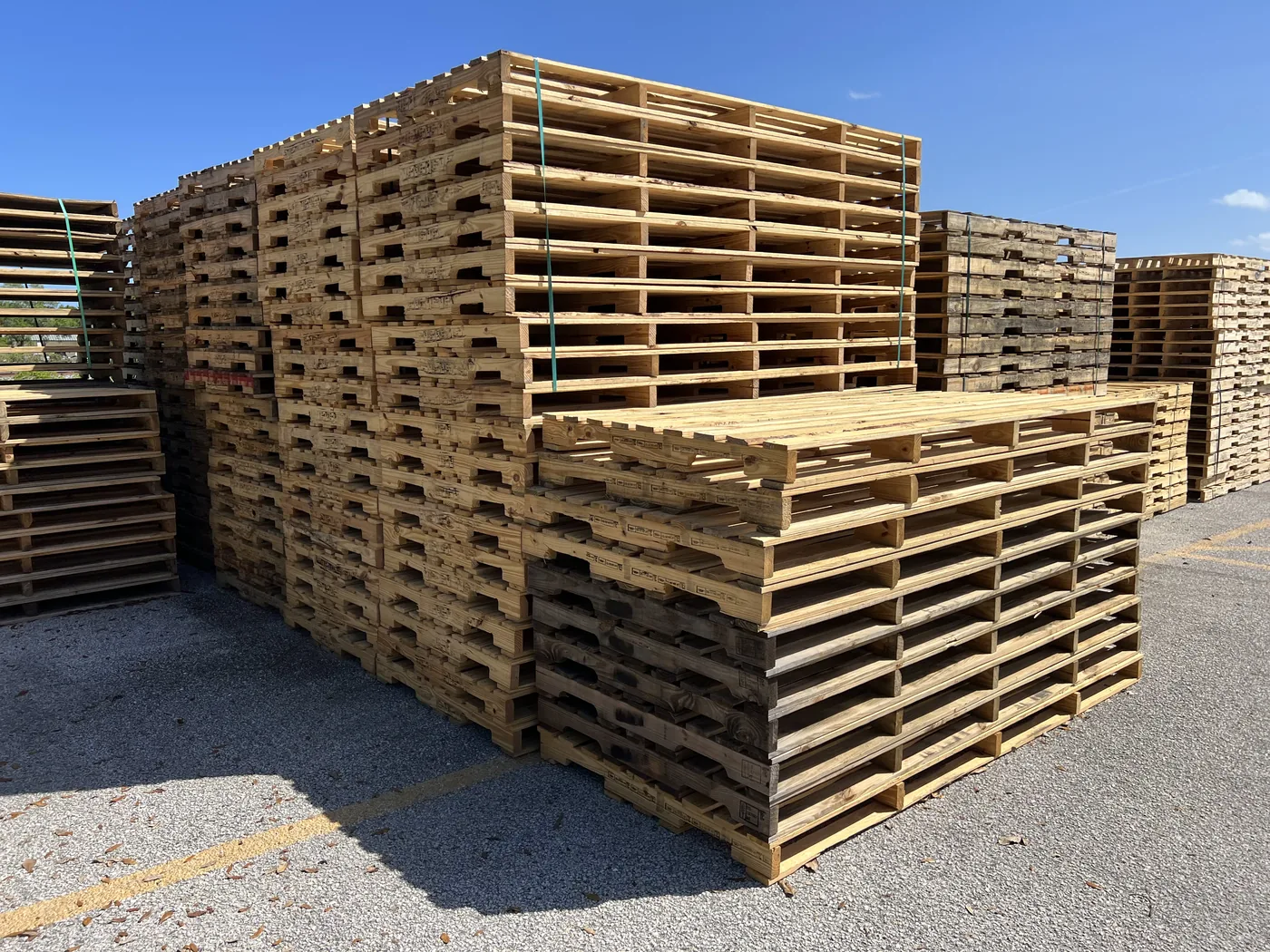
GMA 48x40 four-way stringer construction conforms to the National Wooden Pallet & Container Association (NWPCA) 2014 Uniform Standard; deck board configuration 7-board top, 5-board bottom.
Chicago Tribune-published wholesale grocery cooperatives use returnable-pallet programs; our buyback pricing for Grade A returns supports cost-control for SUPERVALU, Kehe, and UNFI distribution networks.
Illinois EPA Section 22.6 of the Environmental Protection Act regulates wood pallet recycling; our partner facilities in Chicago, Rockford, and Peoria maintain Illinois EPA registration for return-stream service.
Recycled-Grade B pallets meet structural spec but may have up to 2 replaced deck boards; suitable for industrial loads outside food/pharma; price point 30-40% below new GMA.
Lumber spec for new GMA stock: mixed hardwood (oak, maple, ash, hickory) with minimum 600 SG (specific gravity); kiln dried to <19% moisture; visible defects limited to wane on outer 1/3 of deck board only.
Drop-trailer programs maintain a customer-dedicated 53-foot trailer on-site; we swap full-for-empty on a scheduled 24/48/72-hour rotation; preferred for high-throughput dock operations.
Citrus packhouses operate seasonal volume peaks November-April; we maintain dedicated Polk County and Indian River inventory to support 6-12 truckload weekly delivery during peak; standing-order pricing locks rates Oct 1.
Buyback pricing for returned pallets: $3-5 per Grade A unit; $1-2 per Grade B; minimum 50-pallet pickup; integrated with our recycling stream for sustainability accounting.
Sustainability reports provided quarterly to standing-order customers; documents pallets recycled, lumber diverted from landfill, and CO2-equivalent savings vs new-only sourcing.