Industry-tuned block pallets - four-way entry for seafood & meat processing buyers across California.
Get a Price →Industrial-scale Block Pallets - Four-Way Entry for Seafood & Meat Processing for California, California customers requires more than just stock on hand - it requires consistent dimensional tolerances, batch-quality records, and documentation that satisfies SOX, FDA, USDA, ISO 9001, and similar audit frameworks. United States Pallets ships every Block Pallets - Four-Way Entry for Seafood & Meat Processing load with the documentation packet pre-attached electronically, no dock-side delays.
Pallet demand in California, California is shaped by the local economy and the regional supply chain - distribution, manufacturing, and food/beverage operations all consume pallets at predictable cadences. United States Pallets aligns our Block Pallets - Four-Way Entry for Seafood & Meat Processing delivery rhythm to those operations, with same-day rush options when production schedules tighten and standing-order programs for predictable weekly volume.
Yes. Standing-order programs for California operations running 500+ pallets/week lock in tiered pricing, reserve delivery slots, and run on autopilot in the background. Custom contract terms available for accounts running 2,000+/week.
Net-30 credit terms standard after the first 1-3 prepaid or COD loads while credit is being established. Submit a credit application with three trade references; approval typically processes within 48 hours. Volume accounts can negotiate net-45 or net-60.
50 pallets per order minimum on buy-side. Sell-side (buyback) minimum is 250 pallets per single-size load. Volume tiers kick in automatically as cumulative monthly volume increases - 500+/week accounts qualify for standing-order programs with reserved delivery slots.
BOL, packing list, grade certifications standard. Heat-treated loads add IPPC stamps and ISPM-15 documentation. Pharma-grade loads add batch records. Food-grade loads add FSMA Sanitary Transportation Rule certifications. All documentation ships electronically before delivery.
Yes. Backhaul logistics are coordinated on outbound delivery routes - empty or non-spec pallets get picked up on the return leg of new pallet deliveries. Per-pallet freight cost on the backhaul approaches zero for accounts running both new-pallet purchase + buyback simultaneously.
Response under 2 business hours.
Kiln-dried hardwood meets NWPCA Uniform Standard for Wood Pallets; moisture content verified <19% at dispatch, blade-cut deck boards, no visible bark.
California Air Resources Board (CARB) Phase 2 formaldehyde rule restricts composite wood components; our solid hardwood pallets are CARB-exempt and ship with documentation for LA, Long Beach, and Oakland port shipments.
California wildfire compliance under SB 1241 requires fire-resistant materials within 30-foot defensible-space zones; our heat-treated solid hardwood meets Class A fire rating for staging areas outside structures.
ISPM-15 export pallets receive heat treatment to 56C core temperature for 30 minutes; stamping shows IPPC logo, country code 'US', registered facility number, and treatment code 'HT'.
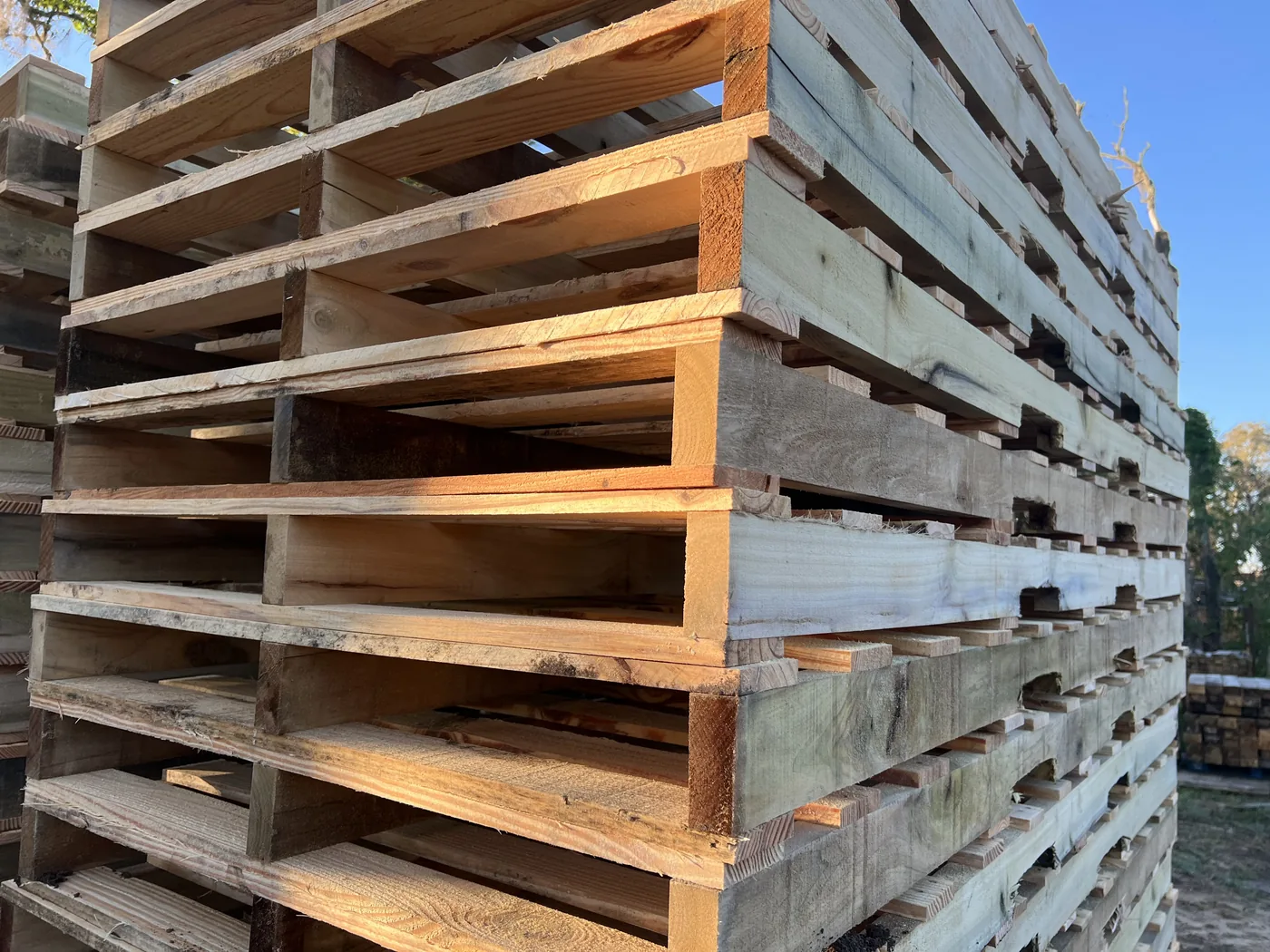
Block pallets (four-way entry) use nine 4-inch hardwood blocks with continuous-face top deck; ideal for ASRS (automated storage and retrieval) and AGV (automated guided vehicle) operations where stringer interruptions cause read-failures.
Buyback programs pay current market rate for returned pallets in Grade A condition; minimum 50 pallets per pickup; integrated with our recycling stream for sustainability reporting.
Concrete and aggregate suppliers use bagged-goods stringers (heavier construction, denser nail pattern) to support 4,000+ lb cement-sack loads; we stock these in our Tampa Bay and Jacksonville warehouses.
Delivery freight runs $250-450 per truckload (53-foot) within 75 miles of a yard; longer hauls priced at $2.50-3.50 per loaded mile; flatbed loads premium 10-15%.
Our Lakeland and Jacksonville recycling streams process 200,000+ pallets per year; broken stock is repaired or chipped for mulch (sold separately); zero-landfill goal targeted for 2027.