Industry-tuned block pallets - four-way entry for sporting goods buyers across Wyoming.
Get a Price →Block Pallets - Four-Way Entry for Sporting Goods in Wyoming, Wyoming is foundational infrastructure for any commercial operation moving goods through Wyoming's industrial supply chain. United States Pallets (Wyoming customers reach us at our national dispatch line) provides Block Pallets - Four-Way Entry for Sporting Goods on a 50-pallet minimum with same-day shipping in our Southeast/Mid-Atlantic core and scheduled weekly delivery to Wyoming elsewhere.
Block Pallets - Four-Way Entry for Sporting Goods suppliers serving Wyoming businesses range from regional yards with limited inventory to national networks with deep multi-grade stock. United States Pallets sits in the second category, structured specifically for high-volume B2B operations - 50+ pallets per order minimum, scheduled programs for 500+/week accounts, and dimensional consistency tight enough for AGV-equipped warehouses.
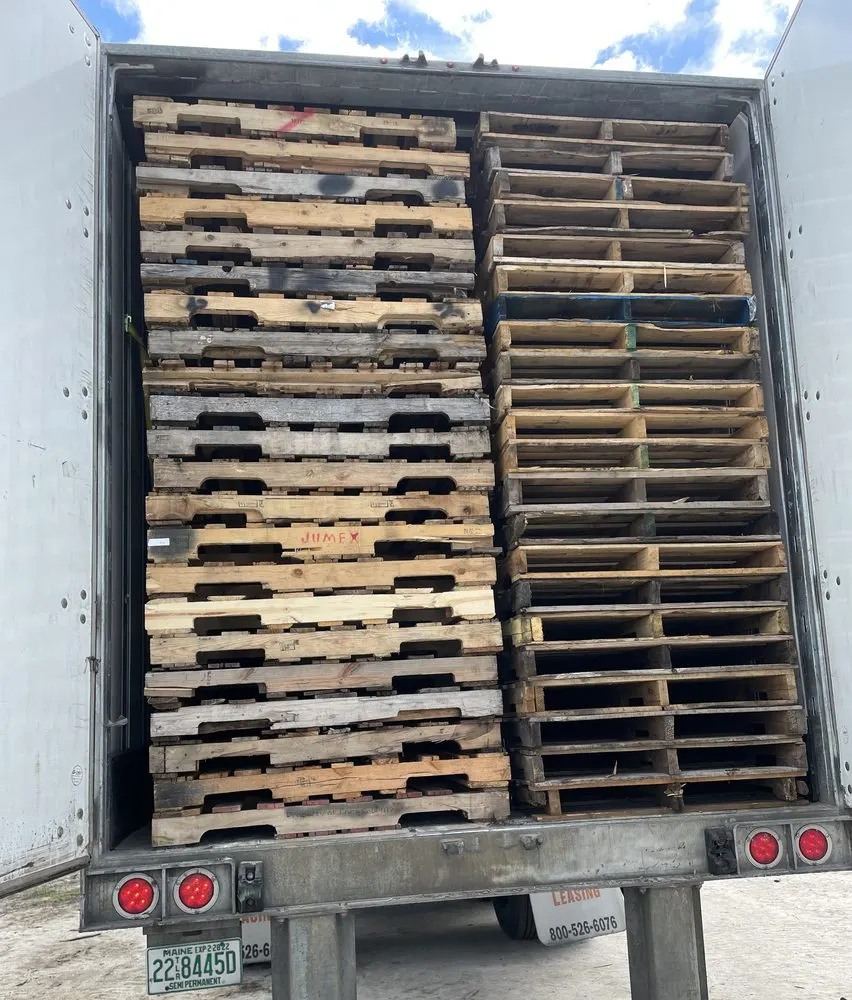
Same-day shipping in our Southeast/Mid-Atlantic core (FL, GA, AL, TN, MS, SC, NC, KY, VA) and scheduled weekly delivery elsewhere. Express options available for Wyoming rush orders. Quote response under 2 business hours, dispatch within hours of order confirmation.
50 pallets per order minimum on buy-side. Sell-side (buyback) minimum is 250 pallets per single-size load. Volume tiers kick in automatically as cumulative monthly volume increases - 500+/week accounts qualify for standing-order programs with reserved delivery slots.
Yes. Backhaul logistics are coordinated on outbound delivery routes - empty or non-spec pallets get picked up on the return leg of new pallet deliveries. Per-pallet freight cost on the backhaul approaches zero for accounts running both new-pallet purchase + buyback simultaneously.
BOL, packing list, grade certifications standard. Heat-treated loads add IPPC stamps and ISPM-15 documentation. Pharma-grade loads add batch records. Food-grade loads add FSMA Sanitary Transportation Rule certifications. All documentation ships electronically before delivery.
Net-30 credit terms standard after the first 1-3 prepaid or COD loads while credit is being established. Submit a credit application with three trade references; approval typically processes within 48 hours. Volume accounts can negotiate net-45 or net-60.
Response under 2 business hours.
GMA 48x40 four-way stringer construction conforms to the National Wooden Pallet & Container Association (NWPCA) 2014 Uniform Standard; deck board configuration 7-board top, 5-board bottom.
Dry-van loads handle weather-sensitive pallet stock and food-grade freight; sealed loads with bill-of-lading documentation; supports DOT-required commercial routing.
Live-load operations bring the trailer to your dock for a 90-minute window; loader/unloader provided; suited to customers without dedicated dock space or with intermittent volume.
Block pallets (four-way entry) use nine 4-inch hardwood blocks with continuous-face top deck; ideal for ASRS (automated storage and retrieval) and AGV (automated guided vehicle) operations where stringer interruptions cause read-failures.
Pallet weight: new GMA averages 38-42 lb per unit; recycled Grade A averages 35-39 lb; lighter chemical-industry 40x40 pallets weigh 28-32 lb; freight estimation should use 40 lb/pallet for inbound planning.
Buyback programs pay current market rate for returned pallets in Grade A condition; minimum 50 pallets per pickup; integrated with our recycling stream for sustainability reporting.
Concrete and aggregate suppliers use bagged-goods stringers (heavier construction, denser nail pattern) to support 4,000+ lb cement-sack loads; we stock these in our Tampa Bay and Jacksonville warehouses.
Custom pallet pricing depends on lumber spec, build complexity, and quantity: small runs (50-200 units) typically $35-55 per unit; large runs (500+ units) drop to $22-32 per unit; quotes returned in <2 hours.
Sustainability reports provided quarterly to standing-order customers; documents pallets recycled, lumber diverted from landfill, and CO2-equivalent savings vs new-only sourcing.