Industry-tuned cold-chain kiln-dried pallets for bakery & confectionery buyers across Georgia.
Get a Price →Pallet demand in Georgia, Georgia is shaped by the local economy and the regional supply chain - distribution, manufacturing, and food/beverage operations all consume pallets at predictable cadences. United States Pallets aligns our Cold-Chain Kiln-Dried Pallets for Bakery & Confectionery delivery rhythm to those operations, with same-day rush options when production schedules tighten and standing-order programs for predictable weekly volume.
Cold-Chain Kiln-Dried Pallets for Bakery & Confectionery in Georgia, Georgia is foundational infrastructure for any commercial operation moving goods through Georgia's industrial supply chain. United States Pallets (Georgia customers reach us at our national dispatch line) provides Cold-Chain Kiln-Dried Pallets for Bakery & Confectionery on a 50-pallet minimum with same-day shipping in our Southeast/Mid-Atlantic core and scheduled weekly delivery to Georgia elsewhere.
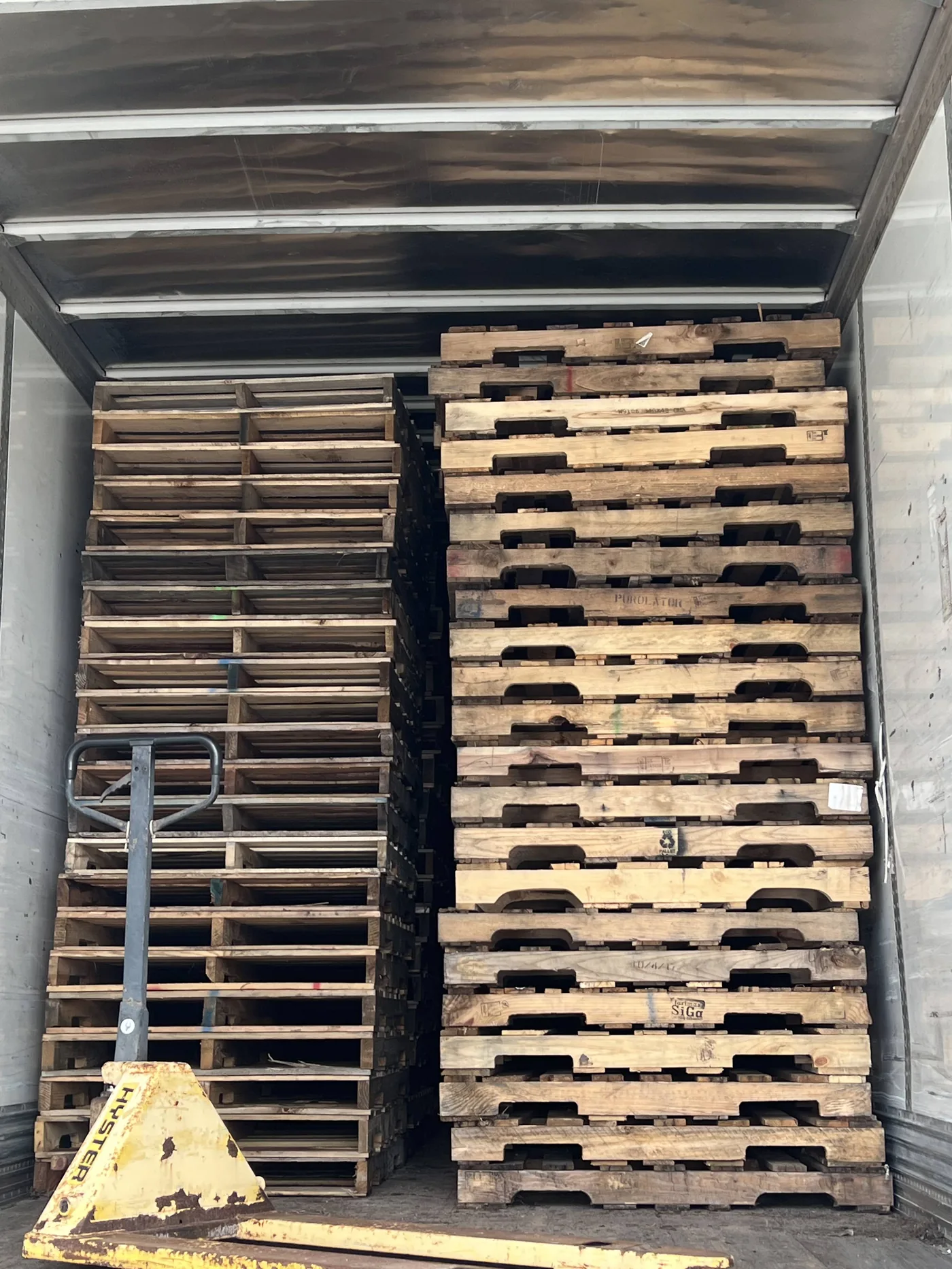
Yes. Backhaul logistics are coordinated on outbound delivery routes - empty or non-spec pallets get picked up on the return leg of new pallet deliveries. Per-pallet freight cost on the backhaul approaches zero for accounts running both new-pallet purchase + buyback simultaneously.
BOL, packing list, grade certifications standard. Heat-treated loads add IPPC stamps and ISPM-15 documentation. Pharma-grade loads add batch records. Food-grade loads add FSMA Sanitary Transportation Rule certifications. All documentation ships electronically before delivery.
Yes. Standing-order programs for Georgia operations running 500+ pallets/week lock in tiered pricing, reserve delivery slots, and run on autopilot in the background. Custom contract terms available for accounts running 2,000+/week.
50 pallets per order minimum on buy-side. Sell-side (buyback) minimum is 250 pallets per single-size load. Volume tiers kick in automatically as cumulative monthly volume increases - 500+/week accounts qualify for standing-order programs with reserved delivery slots.
Yes. We buy back used pallets from Georgia collectors, recyclers, and warehouses - 250-pallet minimum per load, single-size only (no mixed-size loads). Fast ACH payment, typically same-day or net-7 depending on volume. Pickup arranged on standard outbound delivery routes.
Response under 2 business hours.
All pallets stamped IPPC HT for ISPM-15 export compliance to 180+ countries; documentation includes treatment temperature logs and the registered facility number.
Georgia Department of Transportation oversize-load permits restrict pallet shipments above 80,000 lb GVW; our DOT-permitted carriers handle Atlanta-area, Macon-corridor, and coastal Savannah-Brunswick routing.
Port of Savannah Garden City Terminal and Ocean Terminal require ISPM-15 stamp verification; we coordinate with Ports America and APM Terminals inspectors for certified export loads, the busiest container port on the South Atlantic.
ISPM-15 export pallets receive heat treatment to 56C core temperature for 30 minutes; stamping shows IPPC logo, country code 'US', registered facility number, and treatment code 'HT'.
Block pallets (four-way entry) use nine 4-inch hardwood blocks with continuous-face top deck; ideal for ASRS (automated storage and retrieval) and AGV (automated guided vehicle) operations where stringer interruptions cause read-failures.
Buyback programs pay current market rate for returned pallets in Grade A condition; minimum 50 pallets per pickup; integrated with our recycling stream for sustainability reporting.
Cold storage facilities (Plant City corridor) use HDPE plastic pallets that wash down at 180F; suitable for USDA Grade A dairy plants and frozen-protein operations; we lease as well as sell.
Delivery freight runs $250-450 per truckload (53-foot) within 75 miles of a yard; longer hauls priced at $2.50-3.50 per loaded mile; flatbed loads premium 10-15%.
Lumber sourcing prioritizes regional Southeast US hardwood mills (FL, AL, GA, MS); reduces transport carbon vs Pacific Northwest stock; supports regional logging economies.