Industry-tuned custom-size pallets for food & beverage distribution buyers across Washington.
Get a Price →Industrial-scale Custom-Size Pallets for Food & Beverage Distribution for Washington, Washington customers requires more than just stock on hand - it requires consistent dimensional tolerances, batch-quality records, and documentation that satisfies SOX, FDA, USDA, ISO 9001, and similar audit frameworks. United States Pallets ships every Custom-Size Pallets for Food & Beverage Distribution load with the documentation packet pre-attached electronically, no dock-side delays.
Custom-Size Pallets for Food & Beverage Distribution suppliers serving Washington businesses range from regional yards with limited inventory to national networks with deep multi-grade stock. United States Pallets sits in the second category, structured specifically for high-volume B2B operations - 50+ pallets per order minimum, scheduled programs for 500+/week accounts, and dimensional consistency tight enough for AGV-equipped warehouses.
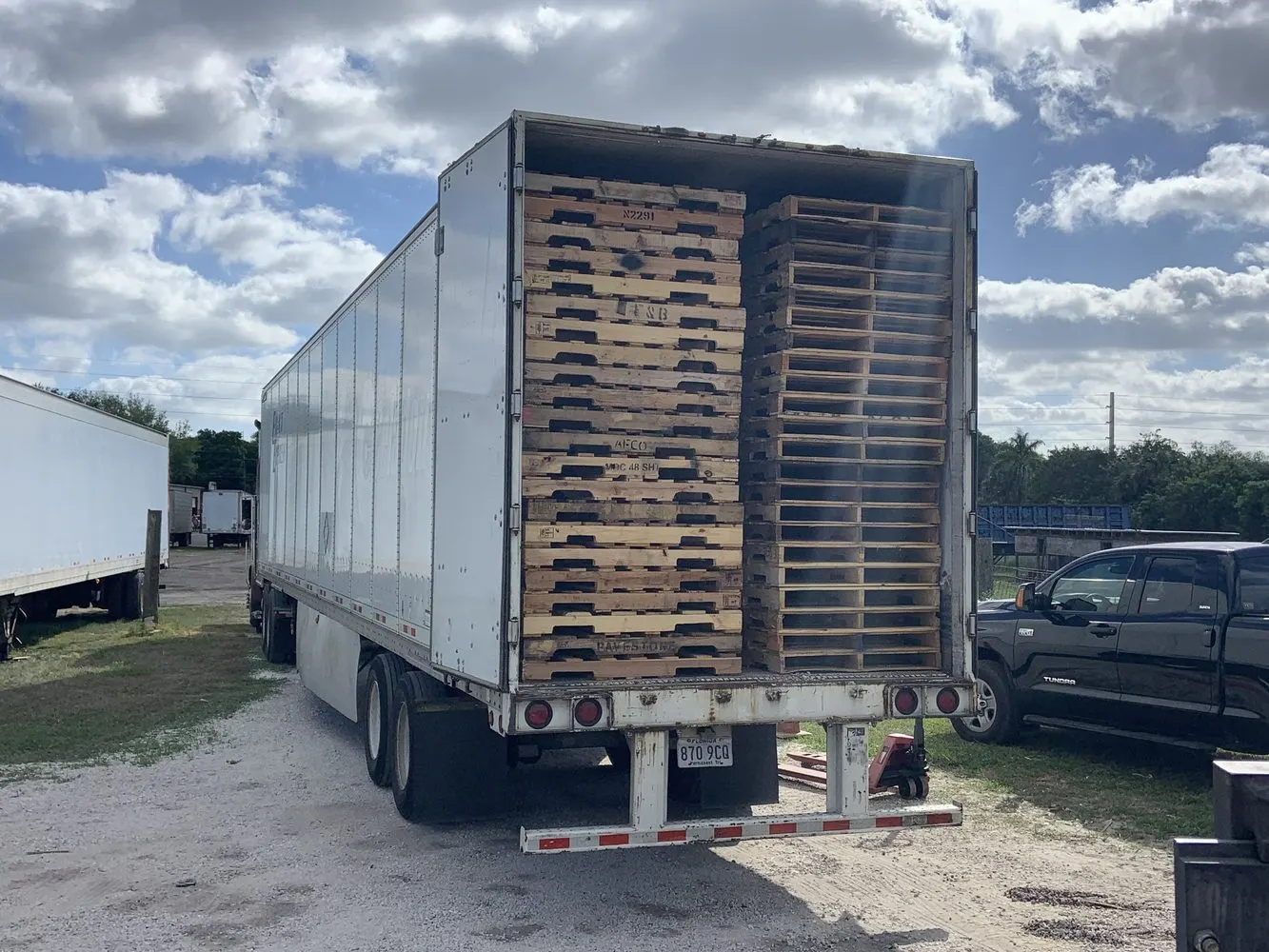
BOL, packing list, grade certifications standard. Heat-treated loads add IPPC stamps and ISPM-15 documentation. Pharma-grade loads add batch records. Food-grade loads add FSMA Sanitary Transportation Rule certifications. All documentation ships electronically before delivery.
Yes. We buy back used pallets from Washington collectors, recyclers, and warehouses - 250-pallet minimum per load, single-size only (no mixed-size loads). Fast ACH payment, typically same-day or net-7 depending on volume. Pickup arranged on standard outbound delivery routes.
Yes, with ISPM-15 heat-treated pallets carrying IPPC stamps and full ISPM-15 documentation. Required for international shipments to all WTO member countries. Common for Washington customers with port access via Washington\'s major export gateways.
Yes. We deliver to every commercial address in Washington, with same-day shipping standard in our Southeast/Mid-Atlantic core and scheduled weekly delivery elsewhere. Washington-area accounts are typical - submit a quote with your dock location and we route accordingly.
Local Washington suppliers offer geographic proximity. United States Pallets offers nationwide sourcing depth, multi-grade inventory always in stock, sub-2-business-hour quote response, audit-ready documentation, and standing-order automation that local yards typically don\'t match.
Response under 2 business hours.
All pallets stamped IPPC HT for ISPM-15 export compliance to 180+ countries; documentation includes treatment temperature logs and the registered facility number.
Washington State Department of Ecology regulates wood pallet recycling under WAC 173-350; our partner facilities in Seattle, Tacoma, and Spokane maintain Ecology registration for return-stream service.
Pacific Northwest forest-products shippers at Port of Longview, Port of Vancouver USA, and Port of Olympia require heavy-duty pallets for lumber, plywood, and OSB loads; we supply reinforced stock rated for sustained 8,000 lb static load.
ISPM-15 export pallets receive heat treatment to 56C core temperature for 30 minutes; stamping shows IPPC logo, country code 'US', registered facility number, and treatment code 'HT'.
48x40 GMA load capacity is 2,800 lb racked (face-loaded), 4,600 lb static, and 2,500 lb dynamic per ASME MH1 2016; deck board span 3.5 inches; deflection under rated load <0.5 inch.
Standard delivery scheduling: orders confirmed by 2 PM EST ship same day from the nearest yard; orders after 2 PM ship next-business-day; weekend dispatch available with 24-hour notice for premium accounts.
Cold storage facilities (Plant City corridor) use HDPE plastic pallets that wash down at 180F; suitable for USDA Grade A dairy plants and frozen-protein operations; we lease as well as sell.
Custom pallet pricing depends on lumber spec, build complexity, and quantity: small runs (50-200 units) typically $35-55 per unit; large runs (500+ units) drop to $22-32 per unit; quotes returned in <2 hours.
Sustainability reports provided quarterly to standing-order customers; documents pallets recycled, lumber diverted from landfill, and CO2-equivalent savings vs new-only sourcing.