Industry-tuned ispm-15 heat-treated export pallets for grocery & retail buyers across North Carolina.
Get a Price →Pallet demand in North Carolina, North Carolina is shaped by the local economy and the regional supply chain - distribution, manufacturing, and food/beverage operations all consume pallets at predictable cadences. United States Pallets aligns our ISPM-15 Heat-Treated Export Pallets for Grocery & Retail delivery rhythm to those operations, with same-day rush options when production schedules tighten and standing-order programs for predictable weekly volume.
North Carolina businesses handling commercial pallet supply for North Carolina-area operations need a supplier that delivers consistent grade quality, dimensional tolerances tighter than industry standard, and audit-ready documentation. United States Pallets ISPM-15 Heat-Treated Export Pallets for Grocery & Retail for North Carolina meets each of those bars, with quote response under 2 business hours and net-30 credit terms after the first 1-3 prepaid loads.
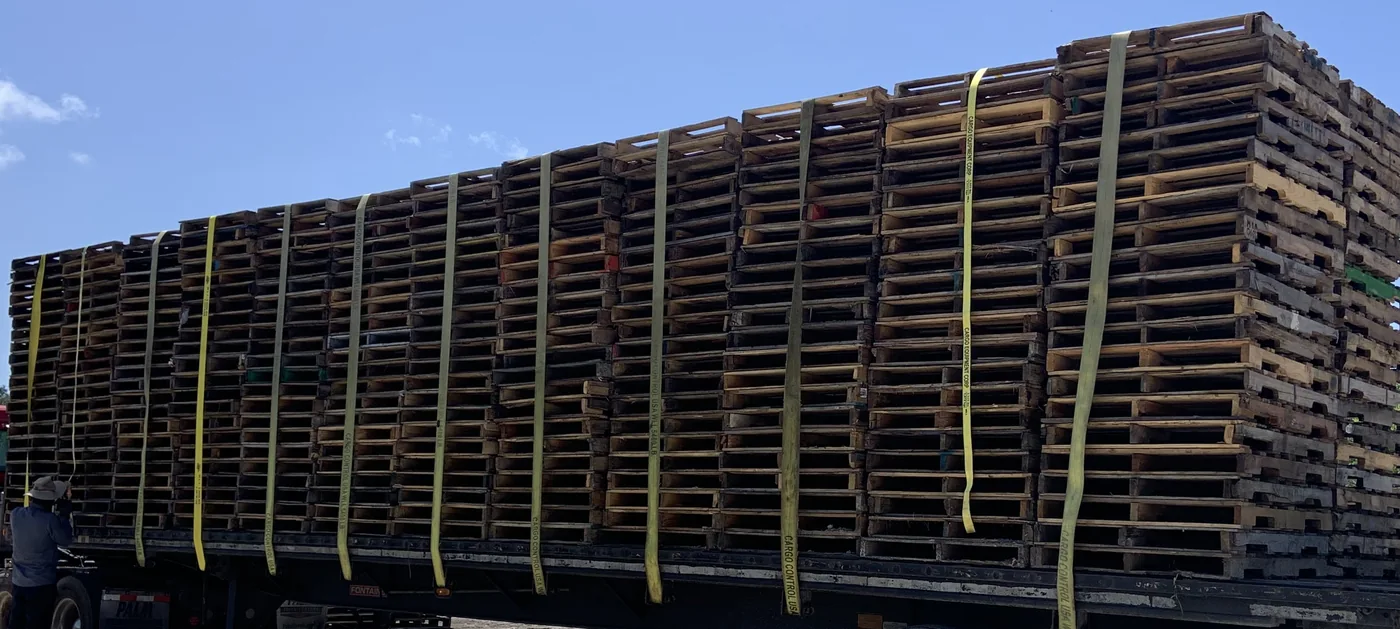
Yes. Backhaul logistics are coordinated on outbound delivery routes - empty or non-spec pallets get picked up on the return leg of new pallet deliveries. Per-pallet freight cost on the backhaul approaches zero for accounts running both new-pallet purchase + buyback simultaneously.
Yes. We deliver to every commercial address in North Carolina, with same-day shipping standard in our Southeast/Mid-Atlantic core and scheduled weekly delivery elsewhere. North Carolina-area accounts are typical - submit a quote with your dock location and we route accordingly.
Net-30 credit terms standard after the first 1-3 prepaid or COD loads while credit is being established. Submit a credit application with three trade references; approval typically processes within 48 hours. Volume accounts can negotiate net-45 or net-60.
Yes, with ISPM-15 heat-treated pallets carrying IPPC stamps and full ISPM-15 documentation. Required for international shipments to all WTO member countries. Common for North Carolina customers with port access via North Carolina\'s major export gateways.
Same-day shipping in our Southeast/Mid-Atlantic core (FL, GA, AL, TN, MS, SC, NC, KY, VA) and scheduled weekly delivery elsewhere. Express options available for North Carolina rush orders. Quote response under 2 business hours, dispatch within hours of order confirmation.
Response under 2 business hours.
GMA 48x40 four-way stringer construction conforms to the National Wooden Pallet & Container Association (NWPCA) 2014 Uniform Standard; deck board configuration 7-board top, 5-board bottom.
North Carolina furniture manufacturers in High Point, Hickory, and Lenoir use custom oversized pallets for assembled freight; 60x40 and 72x48 builds available on 5-day production lead time for furniture-market exhibitors.
North Carolina Department of Environmental Quality regulates wood pallet recycling under 15A NCAC 13B; our partner facilities in Charlotte, Raleigh, and Greensboro maintain NCDEQ registration for return-stream service.
Standard 48x40 GMA pallets feature 5/8 inch deck boards with a 4-board face pattern; bottom configuration is 3-board for four-way fork entry; nail pattern uses 2.5 inch screw-shank galvanized fasteners.
Custom 42x42 pallet builds use 7/8 inch deck boards for telecommunications-equipment loads; nail-pattern density doubled to handle 5,000 lb static load; runner spacing optimized for 4,000 lb-capacity narrow-aisle reach trucks.
Drop-trailer programs maintain a customer-dedicated 53-foot trailer on-site; we swap full-for-empty on a scheduled 24/48/72-hour rotation; preferred for high-throughput dock operations.
Citrus packers in Indian River County require Florida-specific phytosanitary documentation per USDA Marketing Order 905; we provide the documentation on every load.
Pricing structure: new 48x40 GMA stock ranges $14-18 per pallet in 500+ lot pricing; recycled Grade A runs $7-10 per pallet; recycled Grade B at $5-7; custom builds priced per spec on a quote basis.
Our Lakeland and Jacksonville recycling streams process 200,000+ pallets per year; broken stock is repaired or chipped for mulch (sold separately); zero-landfill goal targeted for 2027.