Industry-tuned recycled pallets - grade a & b for appliances & consumer goods buyers across Mississippi.
Get a Price →Recycled Pallets - Grade A & B for Appliances & Consumer Goods in Mississippi, Mississippi is foundational infrastructure for any commercial operation moving goods through Mississippi's industrial supply chain. United States Pallets (Mississippi customers reach us at our national dispatch line) provides Recycled Pallets - Grade A & B for Appliances & Consumer Goods on a 50-pallet minimum with same-day shipping in our Southeast/Mid-Atlantic core and scheduled weekly delivery to Mississippi elsewhere.
Industrial-scale Recycled Pallets - Grade A & B for Appliances & Consumer Goods for Mississippi, Mississippi customers requires more than just stock on hand - it requires consistent dimensional tolerances, batch-quality records, and documentation that satisfies SOX, FDA, USDA, ISO 9001, and similar audit frameworks. United States Pallets ships every Recycled Pallets - Grade A & B for Appliances & Consumer Goods load with the documentation packet pre-attached electronically, no dock-side delays.
Net-30 credit terms standard after the first 1-3 prepaid or COD loads while credit is being established. Submit a credit application with three trade references; approval typically processes within 48 hours. Volume accounts can negotiate net-45 or net-60.
Yes. We buy back used pallets from Mississippi collectors, recyclers, and warehouses - 250-pallet minimum per load, single-size only (no mixed-size loads). Fast ACH payment, typically same-day or net-7 depending on volume. Pickup arranged on standard outbound delivery routes.
Yes. Standing-order programs for Mississippi operations running 500+ pallets/week lock in tiered pricing, reserve delivery slots, and run on autopilot in the background. Custom contract terms available for accounts running 2,000+/week.
Yes. We deliver to every commercial address in Mississippi, with same-day shipping standard in our Southeast/Mid-Atlantic core and scheduled weekly delivery elsewhere. Mississippi-area accounts are typical - submit a quote with your dock location and we route accordingly.
Same-day shipping in our Southeast/Mid-Atlantic core (FL, GA, AL, TN, MS, SC, NC, KY, VA) and scheduled weekly delivery elsewhere. Express options available for Mississippi rush orders. Quote response under 2 business hours, dispatch within hours of order confirmation.
Response under 2 business hours.
All pallets stamped IPPC HT for ISPM-15 export compliance to 180+ countries; documentation includes treatment temperature logs and the registered facility number.
Standard delivery scheduling: orders confirmed by 2 PM EST ship same day from the nearest yard; orders after 2 PM ship next-business-day; weekend dispatch available with 24-hour notice for premium accounts.
Buyback programs pay current market rate for returned pallets in Grade A condition; minimum 50 pallets per pickup; integrated with our recycling stream for sustainability reporting.
48x40 GMA load capacity is 2,800 lb racked (face-loaded), 4,600 lb static, and 2,500 lb dynamic per ASME MH1 2016; deck board span 3.5 inches; deflection under rated load <0.5 inch.
Block pallets (four-way entry) use nine 4-inch hardwood blocks with continuous-face top deck; ideal for ASRS (automated storage and retrieval) and AGV (automated guided vehicle) operations where stringer interruptions cause read-failures.
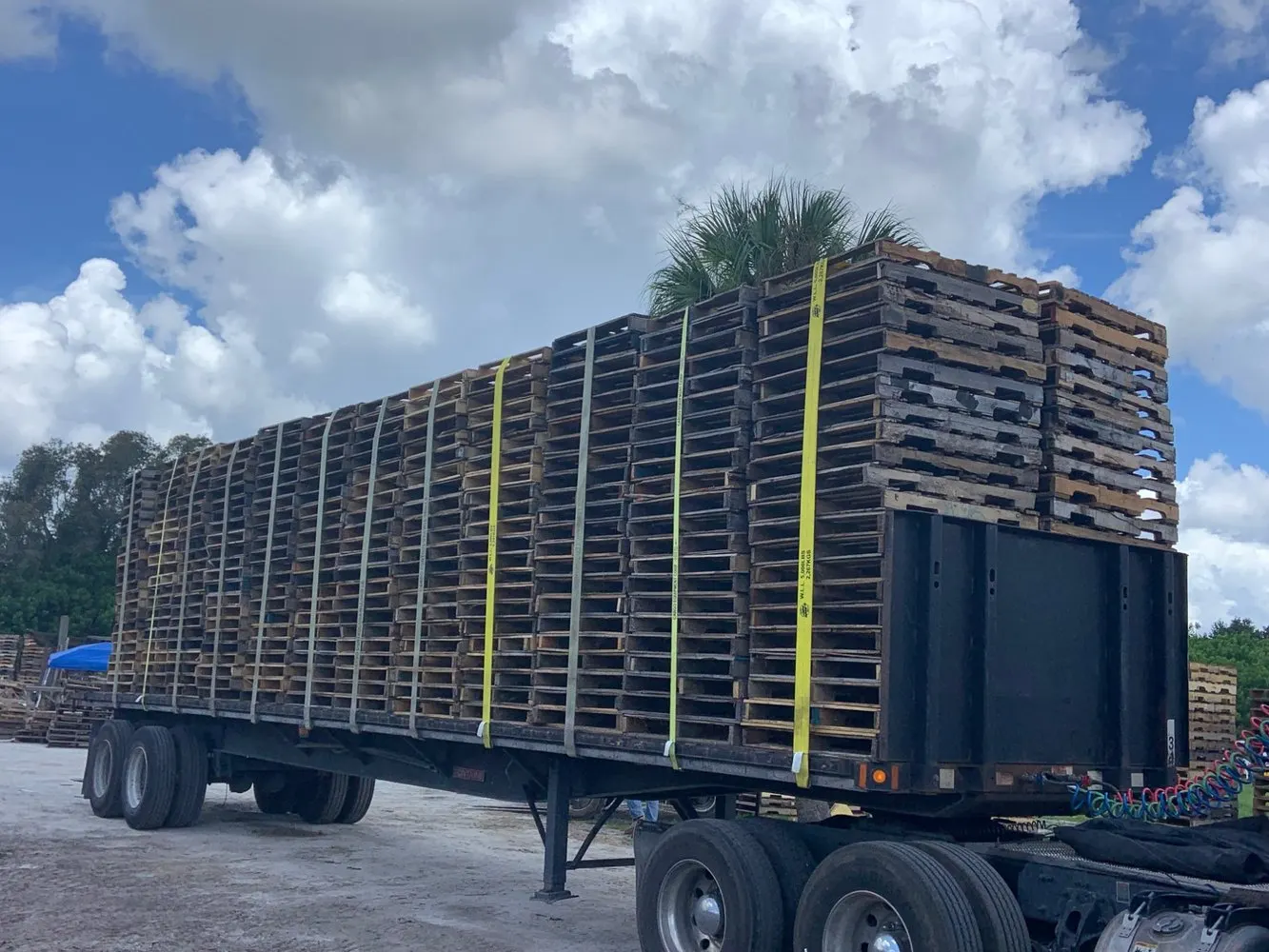
Flatbed delivery handles oversized loads or pallets with overhanging product; tarping included; preferred for export crates and bulk lumber shipments.
Marine industry suppliers (Fort Lauderdale, Stuart, Miami) use exterior-rated pallets that resist saltwater corrosion; treated lumber stock available; preferred for boat-component freight to Bahamas and Caribbean.
Delivery freight runs $250-450 per truckload (53-foot) within 75 miles of a yard; longer hauls priced at $2.50-3.50 per loaded mile; flatbed loads premium 10-15%.
Sustainability reports provided quarterly to standing-order customers; documents pallets recycled, lumber diverted from landfill, and CO2-equivalent savings vs new-only sourcing.