Industry-tuned recycled pallets - grade a & b for frozen foods buyers across North Carolina.
Get a Price →Recycled Pallets - Grade A & B for Frozen Foods in North Carolina, North Carolina is foundational infrastructure for any commercial operation moving goods through North Carolina's industrial supply chain. United States Pallets (North Carolina customers reach us at our national dispatch line) provides Recycled Pallets - Grade A & B for Frozen Foods on a 50-pallet minimum with same-day shipping in our Southeast/Mid-Atlantic core and scheduled weekly delivery to North Carolina elsewhere.
Recycled Pallets - Grade A & B for Frozen Foods suppliers serving North Carolina businesses range from regional yards with limited inventory to national networks with deep multi-grade stock. United States Pallets sits in the second category, structured specifically for high-volume B2B operations - 50+ pallets per order minimum, scheduled programs for 500+/week accounts, and dimensional consistency tight enough for AGV-equipped warehouses.
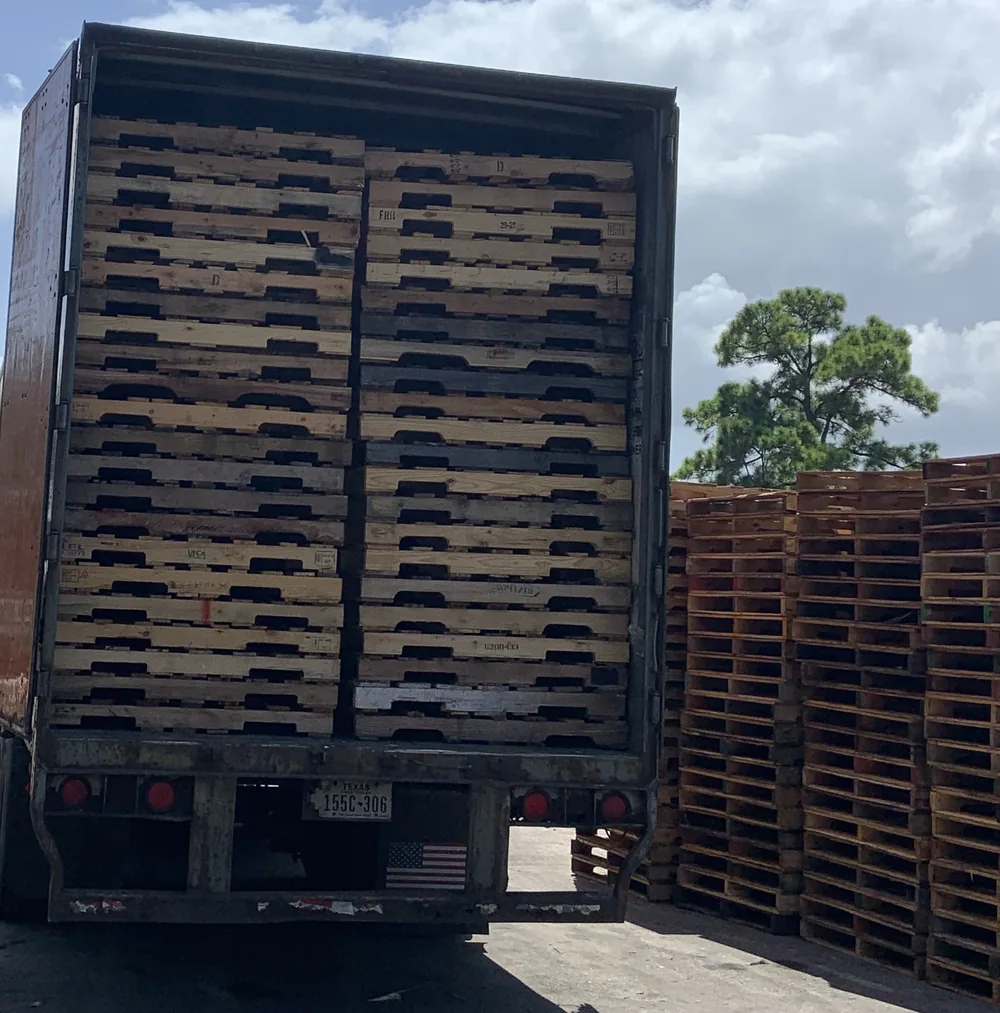
Local North Carolina suppliers offer geographic proximity. United States Pallets offers nationwide sourcing depth, multi-grade inventory always in stock, sub-2-business-hour quote response, audit-ready documentation, and standing-order automation that local yards typically don\'t match.
Same-day shipping in our Southeast/Mid-Atlantic core (FL, GA, AL, TN, MS, SC, NC, KY, VA) and scheduled weekly delivery elsewhere. Express options available for North Carolina rush orders. Quote response under 2 business hours, dispatch within hours of order confirmation.
Yes, with ISPM-15 heat-treated pallets carrying IPPC stamps and full ISPM-15 documentation. Required for international shipments to all WTO member countries. Common for North Carolina customers with port access via North Carolina\'s major export gateways.
50 pallets per order minimum on buy-side. Sell-side (buyback) minimum is 250 pallets per single-size load. Volume tiers kick in automatically as cumulative monthly volume increases - 500+/week accounts qualify for standing-order programs with reserved delivery slots.
Yes. Backhaul logistics are coordinated on outbound delivery routes - empty or non-spec pallets get picked up on the return leg of new pallet deliveries. Per-pallet freight cost on the backhaul approaches zero for accounts running both new-pallet purchase + buyback simultaneously.
Response under 2 business hours.
Heat-treatment chamber maintained at 56C core for 30 minutes per ISPM-15 Annex 1; each load shipped with a treatment certificate signed by a USDA-registered inspector.
North Carolina furniture manufacturers in High Point, Hickory, and Lenoir use custom oversized pallets for assembled freight; 60x40 and 72x48 builds available on 5-day production lead time for furniture-market exhibitors.
Research Triangle pharmaceutical manufacturers in Durham and Research Triangle Park require FDA 21 CFR 178.3520 indirect food additive compliant pallets; our pharma-grade stock serves GSK, Eli Lilly, and Pfizer manufacturing sites.
Deck board edge type defaults to chamfered for forklift safety; square-edge available on request for ASRS compatibility; rounded-edge banding tracks available for high-throughput line-side delivery.
Pallet weight: new GMA averages 38-42 lb per unit; recycled Grade A averages 35-39 lb; lighter chemical-industry 40x40 pallets weigh 28-32 lb; freight estimation should use 40 lb/pallet for inbound planning.
Buyback programs pay current market rate for returned pallets in Grade A condition; minimum 50 pallets per pickup; integrated with our recycling stream for sustainability reporting.
Citrus packhouses operate seasonal volume peaks November-April; we maintain dedicated Polk County and Indian River inventory to support 6-12 truckload weekly delivery during peak; standing-order pricing locks rates Oct 1.
Buyback pricing for returned pallets: $3-5 per Grade A unit; $1-2 per Grade B; minimum 50-pallet pickup; integrated with our recycling stream for sustainability accounting.
Lumber sourcing prioritizes regional Southeast US hardwood mills (FL, AL, GA, MS); reduces transport carbon vs Pacific Northwest stock; supports regional logging economies.