Industry-tuned recycled pallets - grade a & b for grocery & retail buyers across Washington.
Get a Price →Industrial-scale Recycled Pallets - Grade A & B for Grocery & Retail for Washington, Washington customers requires more than just stock on hand - it requires consistent dimensional tolerances, batch-quality records, and documentation that satisfies SOX, FDA, USDA, ISO 9001, and similar audit frameworks. United States Pallets ships every Recycled Pallets - Grade A & B for Grocery & Retail load with the documentation packet pre-attached electronically, no dock-side delays.
When Washington, Washington operations need Recycled Pallets - Grade A & B for Grocery & Retail at scale, the supplier shortlist comes down to three things: inventory depth, delivery reliability, and documentation. United States Pallets engineers our Recycled Pallets - Grade A & B for Grocery & Retail program to win on all three - new GMA stock plus recycled Grade A and B always available, scheduled weekly delivery, and BOL/IPPC/grade certifications electronic before each load arrives.
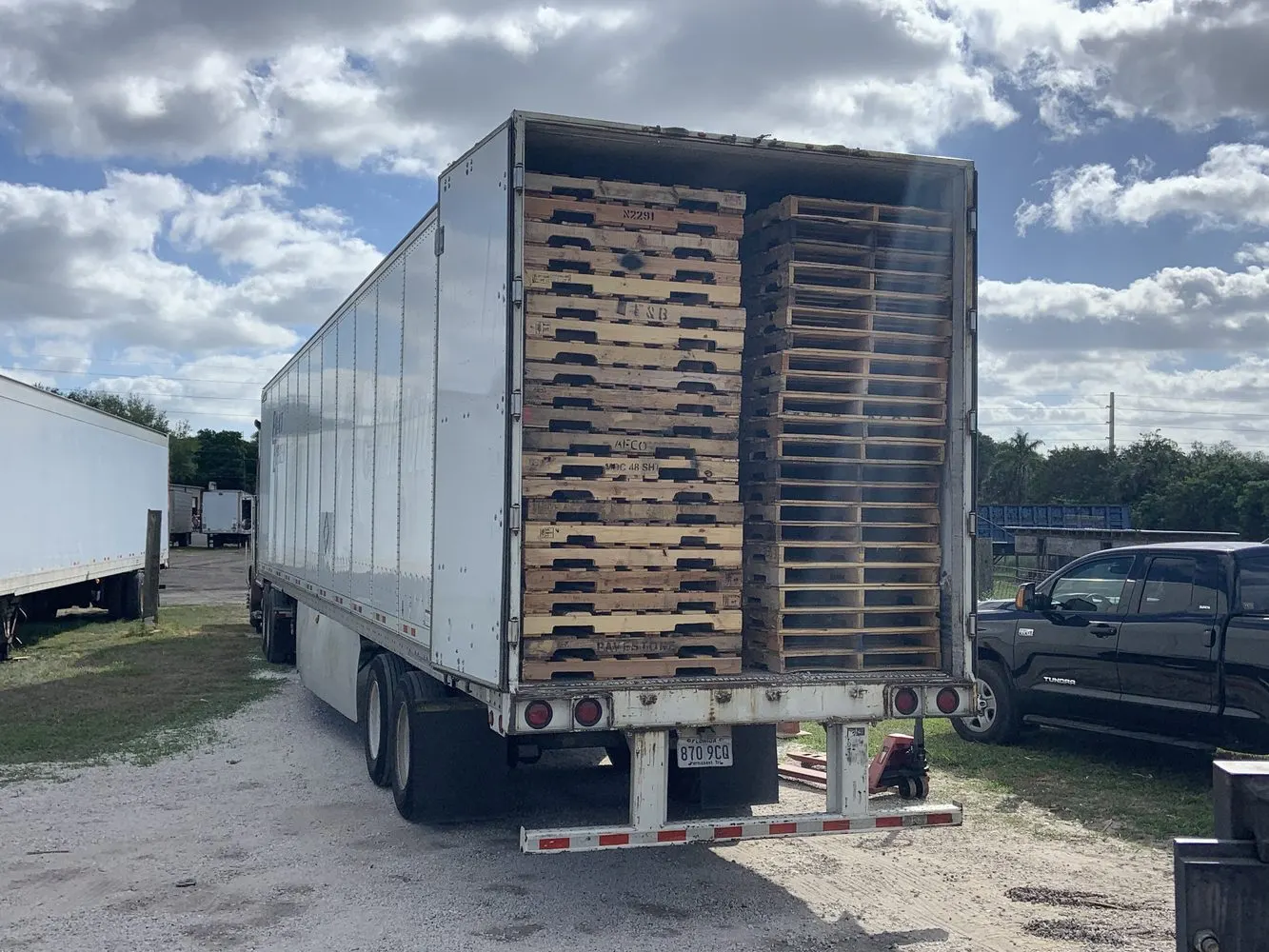
50 pallets per order minimum on buy-side. Sell-side (buyback) minimum is 250 pallets per single-size load. Volume tiers kick in automatically as cumulative monthly volume increases - 500+/week accounts qualify for standing-order programs with reserved delivery slots.
Same-day shipping in our Southeast/Mid-Atlantic core (FL, GA, AL, TN, MS, SC, NC, KY, VA) and scheduled weekly delivery elsewhere. Express options available for Washington rush orders. Quote response under 2 business hours, dispatch within hours of order confirmation.
Yes. We deliver to every commercial address in Washington, with same-day shipping standard in our Southeast/Mid-Atlantic core and scheduled weekly delivery elsewhere. Washington-area accounts are typical - submit a quote with your dock location and we route accordingly.
Local Washington suppliers offer geographic proximity. United States Pallets offers nationwide sourcing depth, multi-grade inventory always in stock, sub-2-business-hour quote response, audit-ready documentation, and standing-order automation that local yards typically don\'t match.
Net-30 credit terms standard after the first 1-3 prepaid or COD loads while credit is being established. Submit a credit application with three trade references; approval typically processes within 48 hours. Volume accounts can negotiate net-45 or net-60.
Response under 2 business hours.
GMA 48x40 four-way stringer construction conforms to the National Wooden Pallet & Container Association (NWPCA) 2014 Uniform Standard; deck board configuration 7-board top, 5-board bottom.
Washington State Department of Agriculture phytosanitary rules require ISPM-15 documentation on pallets carrying treated apples, cherries, and hops; our heat-treated stock with phytosanitary certification serves Wenatchee, Yakima, and Tri-Cities packers.
Washington State Department of Transportation oversize-load permits restrict pallet shipments via I-5, I-90, and I-82; our WSDOT-permitted carriers handle Puget Sound, Yakima Valley, and Spokane-corridor routing.
Pallet weight: new GMA averages 38-42 lb per unit; recycled Grade A averages 35-39 lb; lighter chemical-industry 40x40 pallets weigh 28-32 lb; freight estimation should use 40 lb/pallet for inbound planning.
Block pallets (four-way entry) use nine 4-inch hardwood blocks with continuous-face top deck; ideal for ASRS (automated storage and retrieval) and AGV (automated guided vehicle) operations where stringer interruptions cause read-failures.
Live-load operations bring the trailer to your dock for a 90-minute window; loader/unloader provided; suited to customers without dedicated dock space or with intermittent volume.
Citrus packhouses operate seasonal volume peaks November-April; we maintain dedicated Polk County and Indian River inventory to support 6-12 truckload weekly delivery during peak; standing-order pricing locks rates Oct 1.
Delivery freight runs $250-450 per truckload (53-foot) within 75 miles of a yard; longer hauls priced at $2.50-3.50 per loaded mile; flatbed loads premium 10-15%.
Lumber sourcing prioritizes regional Southeast US hardwood mills (FL, AL, GA, MS); reduces transport carbon vs Pacific Northwest stock; supports regional logging economies.