Industry-tuned recycled pallets - grade a & b for janitorial & sanitation buyers across California.
Get a Price →Pallet demand in California, California is shaped by the local economy and the regional supply chain - distribution, manufacturing, and food/beverage operations all consume pallets at predictable cadences. United States Pallets aligns our Recycled Pallets - Grade A & B for Janitorial & Sanitation delivery rhythm to those operations, with same-day rush options when production schedules tighten and standing-order programs for predictable weekly volume.
Recycled Pallets - Grade A & B for Janitorial & Sanitation suppliers serving California businesses range from regional yards with limited inventory to national networks with deep multi-grade stock. United States Pallets sits in the second category, structured specifically for high-volume B2B operations - 50+ pallets per order minimum, scheduled programs for 500+/week accounts, and dimensional consistency tight enough for AGV-equipped warehouses.
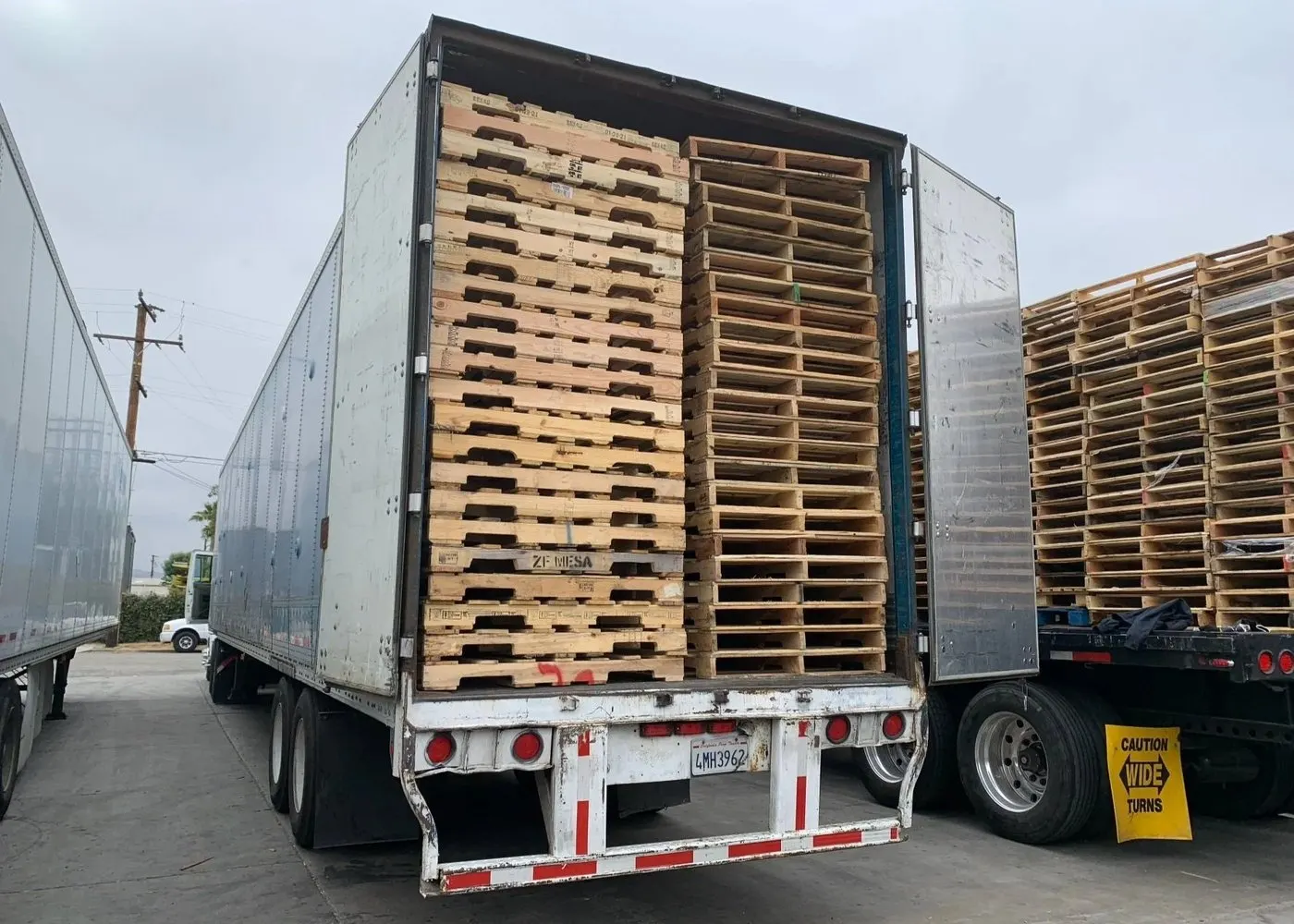
Yes. Backhaul logistics are coordinated on outbound delivery routes - empty or non-spec pallets get picked up on the return leg of new pallet deliveries. Per-pallet freight cost on the backhaul approaches zero for accounts running both new-pallet purchase + buyback simultaneously.
BOL, packing list, grade certifications standard. Heat-treated loads add IPPC stamps and ISPM-15 documentation. Pharma-grade loads add batch records. Food-grade loads add FSMA Sanitary Transportation Rule certifications. All documentation ships electronically before delivery.
Local California suppliers offer geographic proximity. United States Pallets offers nationwide sourcing depth, multi-grade inventory always in stock, sub-2-business-hour quote response, audit-ready documentation, and standing-order automation that local yards typically don\'t match.
Yes, with ISPM-15 heat-treated pallets carrying IPPC stamps and full ISPM-15 documentation. Required for international shipments to all WTO member countries. Common for California customers with port access via California\'s major export gateways.
50 pallets per order minimum on buy-side. Sell-side (buyback) minimum is 250 pallets per single-size load. Volume tiers kick in automatically as cumulative monthly volume increases - 500+/week accounts qualify for standing-order programs with reserved delivery slots.
Response under 2 business hours.
All pallets stamped IPPC HT for ISPM-15 export compliance to 180+ countries; documentation includes treatment temperature logs and the registered facility number.
Central Valley agricultural packers in Bakersfield, Fresno, and Modesto require USDA-compliant phytosanitary documentation for export-bound produce; we maintain seasonal inventory at Stockton and Bakersfield distribution yards.
California Air Resources Board (CARB) Phase 2 formaldehyde rule restricts composite wood components; our solid hardwood pallets are CARB-exempt and ship with documentation for LA, Long Beach, and Oakland port shipments.
Recycled-Grade B pallets meet structural spec but may have up to 2 replaced deck boards; suitable for industrial loads outside food/pharma; price point 30-40% below new GMA.
Recycled-Grade A pallets meet 48x40 GMA spec with cosmetic wear only; no broken boards, no replaced stringers, all original GMA stamp visible; suitable for primary food-grade and pharmaceutical loads.
Drop-trailer programs maintain a customer-dedicated 53-foot trailer on-site; we swap full-for-empty on a scheduled 24/48/72-hour rotation; preferred for high-throughput dock operations.
Aerospace component manufacturers (Brevard, Pinellas counties) use ISPM-15 export crates for international supplier shipments; build-to-print specs include foam-lined interiors and humidity-control packets.
Custom pallet pricing depends on lumber spec, build complexity, and quantity: small runs (50-200 units) typically $35-55 per unit; large runs (500+ units) drop to $22-32 per unit; quotes returned in <2 hours.
Our Lakeland and Jacksonville recycling streams process 200,000+ pallets per year; broken stock is repaired or chipped for mulch (sold separately); zero-landfill goal targeted for 2027.