Industry-tuned recycled pallets - grade a & b for janitorial & sanitation buyers across North Carolina.
Get a Price →North Carolina businesses handling commercial pallet supply for North Carolina-area operations need a supplier that delivers consistent grade quality, dimensional tolerances tighter than industry standard, and audit-ready documentation. United States Pallets Recycled Pallets - Grade A & B for Janitorial & Sanitation for North Carolina meets each of those bars, with quote response under 2 business hours and net-30 credit terms after the first 1-3 prepaid loads.
Pallet demand in North Carolina, North Carolina is shaped by the local economy and the regional supply chain - distribution, manufacturing, and food/beverage operations all consume pallets at predictable cadences. United States Pallets aligns our Recycled Pallets - Grade A & B for Janitorial & Sanitation delivery rhythm to those operations, with same-day rush options when production schedules tighten and standing-order programs for predictable weekly volume.
Yes. We buy back used pallets from North Carolina collectors, recyclers, and warehouses - 250-pallet minimum per load, single-size only (no mixed-size loads). Fast ACH payment, typically same-day or net-7 depending on volume. Pickup arranged on standard outbound delivery routes.
BOL, packing list, grade certifications standard. Heat-treated loads add IPPC stamps and ISPM-15 documentation. Pharma-grade loads add batch records. Food-grade loads add FSMA Sanitary Transportation Rule certifications. All documentation ships electronically before delivery.
50 pallets per order minimum on buy-side. Sell-side (buyback) minimum is 250 pallets per single-size load. Volume tiers kick in automatically as cumulative monthly volume increases - 500+/week accounts qualify for standing-order programs with reserved delivery slots.
Yes. Backhaul logistics are coordinated on outbound delivery routes - empty or non-spec pallets get picked up on the return leg of new pallet deliveries. Per-pallet freight cost on the backhaul approaches zero for accounts running both new-pallet purchase + buyback simultaneously.
Yes. Standing-order programs for North Carolina operations running 500+ pallets/week lock in tiered pricing, reserve delivery slots, and run on autopilot in the background. Custom contract terms available for accounts running 2,000+/week.
Response under 2 business hours.
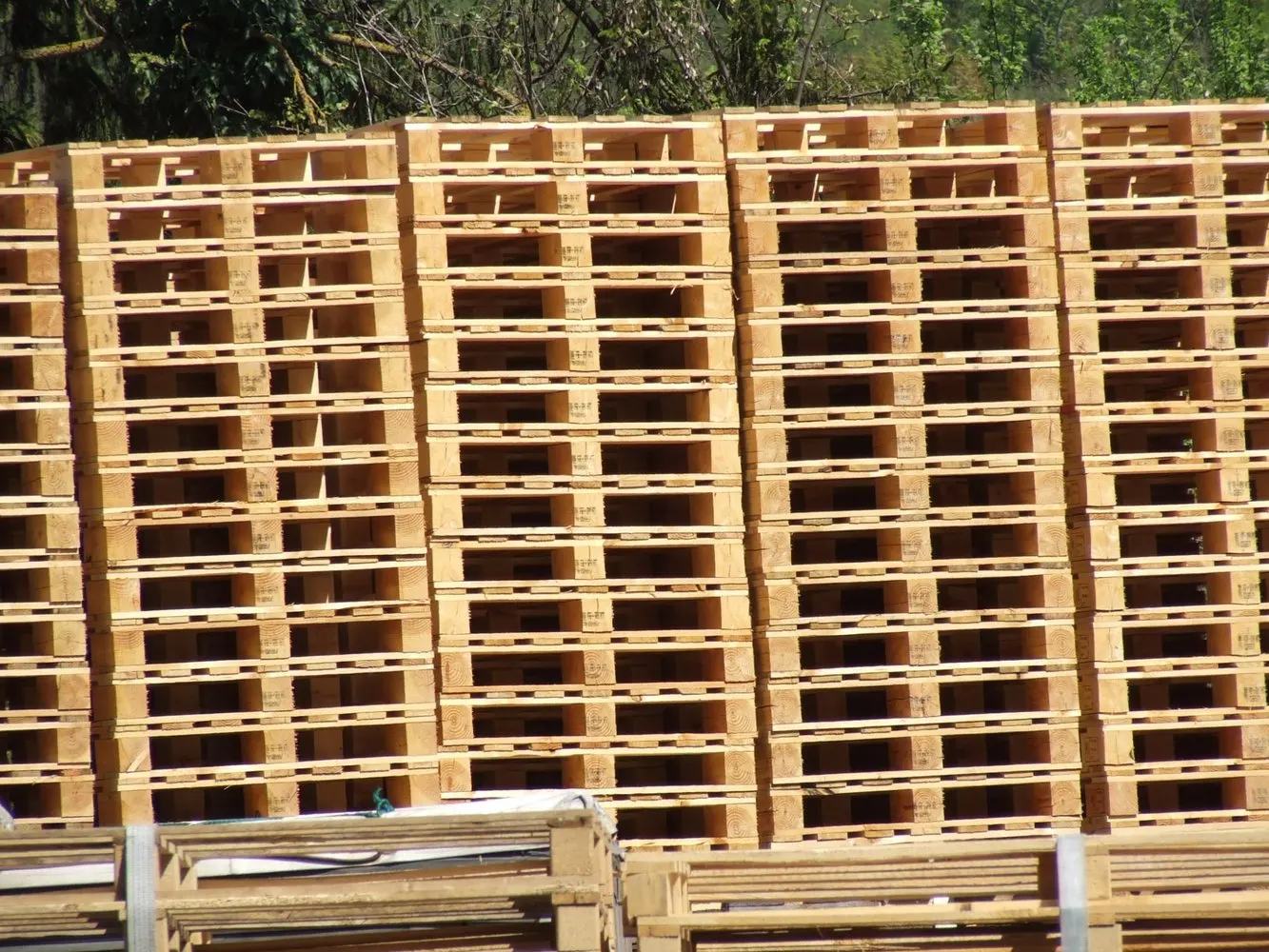
GMA 48x40 four-way stringer construction conforms to the National Wooden Pallet & Container Association (NWPCA) 2014 Uniform Standard; deck board configuration 7-board top, 5-board bottom.
North Carolina Department of Environmental Quality regulates wood pallet recycling under 15A NCAC 13B; our partner facilities in Charlotte, Raleigh, and Greensboro maintain NCDEQ registration for return-stream service.
North Carolina Department of Transportation oversize-load permits restrict pallet shipments via I-40, I-77, and I-95; our DOT-permitted carriers handle Charlotte-area, Triangle-corridor, and coastal Wilmington routing.
ISPM-15 export pallets receive heat treatment to 56C core temperature for 30 minutes; stamping shows IPPC logo, country code 'US', registered facility number, and treatment code 'HT'.
Pallet weight: new GMA averages 38-42 lb per unit; recycled Grade A averages 35-39 lb; lighter chemical-industry 40x40 pallets weigh 28-32 lb; freight estimation should use 40 lb/pallet for inbound planning.
Dry-van loads handle weather-sensitive pallet stock and food-grade freight; sealed loads with bill-of-lading documentation; supports DOT-required commercial routing.
Healthcare and medical-device manufacturers (Pinellas County corridor) use custom foam-lined pallets to protect $50K+ equipment shipments; build-to-print available on 3-day lead time.
Pricing structure: new 48x40 GMA stock ranges $14-18 per pallet in 500+ lot pricing; recycled Grade A runs $7-10 per pallet; recycled Grade B at $5-7; custom builds priced per spec on a quote basis.
Lumber sourcing prioritizes regional Southeast US hardwood mills (FL, AL, GA, MS); reduces transport carbon vs Pacific Northwest stock; supports regional logging economies.