Industry-tuned recycled pallets - grade a & b for lawn & garden supply buyers across North Dakota.
Get a Price →Pallet demand in North Dakota, North Dakota is shaped by the local economy and the regional supply chain - distribution, manufacturing, and food/beverage operations all consume pallets at predictable cadences. United States Pallets aligns our Recycled Pallets - Grade A & B for Lawn & Garden Supply delivery rhythm to those operations, with same-day rush options when production schedules tighten and standing-order programs for predictable weekly volume.
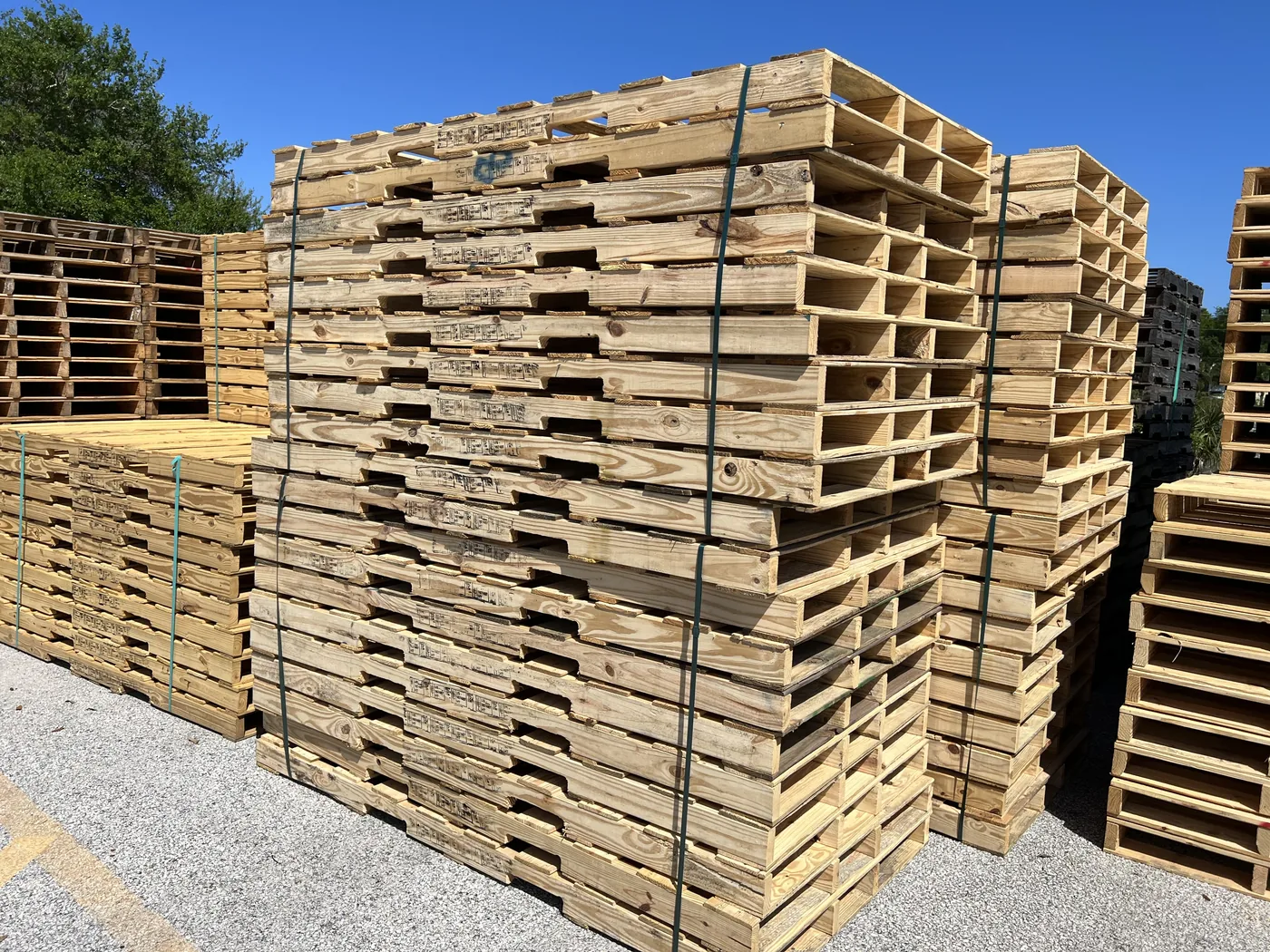
Recycled Pallets - Grade A & B for Lawn & Garden Supply in North Dakota, North Dakota is foundational infrastructure for any commercial operation moving goods through North Dakota's industrial supply chain. United States Pallets (North Dakota customers reach us at our national dispatch line) provides Recycled Pallets - Grade A & B for Lawn & Garden Supply on a 50-pallet minimum with same-day shipping in our Southeast/Mid-Atlantic core and scheduled weekly delivery to North Dakota elsewhere.
Yes. We deliver to every commercial address in North Dakota, with same-day shipping standard in our Southeast/Mid-Atlantic core and scheduled weekly delivery elsewhere. North Dakota-area accounts are typical - submit a quote with your dock location and we route accordingly.
Yes. We buy back used pallets from North Dakota collectors, recyclers, and warehouses - 250-pallet minimum per load, single-size only (no mixed-size loads). Fast ACH payment, typically same-day or net-7 depending on volume. Pickup arranged on standard outbound delivery routes.
Net-30 credit terms standard after the first 1-3 prepaid or COD loads while credit is being established. Submit a credit application with three trade references; approval typically processes within 48 hours. Volume accounts can negotiate net-45 or net-60.
Yes. Backhaul logistics are coordinated on outbound delivery routes - empty or non-spec pallets get picked up on the return leg of new pallet deliveries. Per-pallet freight cost on the backhaul approaches zero for accounts running both new-pallet purchase + buyback simultaneously.
Yes, with ISPM-15 heat-treated pallets carrying IPPC stamps and full ISPM-15 documentation. Required for international shipments to all WTO member countries. Common for North Dakota customers with port access via North Dakota\'s major export gateways.
Response under 2 business hours.
All pallets stamped IPPC HT for ISPM-15 export compliance to 180+ countries; documentation includes treatment temperature logs and the registered facility number.
Dry-van loads handle weather-sensitive pallet stock and food-grade freight; sealed loads with bill-of-lading documentation; supports DOT-required commercial routing.
Live-load operations bring the trailer to your dock for a 90-minute window; loader/unloader provided; suited to customers without dedicated dock space or with intermittent volume.
Block pallets (four-way entry) use nine 4-inch hardwood blocks with continuous-face top deck; ideal for ASRS (automated storage and retrieval) and AGV (automated guided vehicle) operations where stringer interruptions cause read-failures.
Deck board edge type defaults to chamfered for forklift safety; square-edge available on request for ASRS compatibility; rounded-edge banding tracks available for high-throughput line-side delivery.
Same-day delivery available within 75 miles of our Tampa, Orlando, Jacksonville, Miami, and Lakeland yards; minimum 24 pallets; small-order pricing applies on freight.
Construction supply yards (Home Depot, Lowe's distribution) move lumber and hardware on 48x40 GMA in 5,000+ pallet weekly cycles; we supply both the inbound load pallets and the return-stream recycled stock.
Custom pallet pricing depends on lumber spec, build complexity, and quantity: small runs (50-200 units) typically $35-55 per unit; large runs (500+ units) drop to $22-32 per unit; quotes returned in <2 hours.
Sustainability reports provided quarterly to standing-order customers; documents pallets recycled, lumber diverted from landfill, and CO2-equivalent savings vs new-only sourcing.