EUR/EPAL pallets are the dominant European wood pallet standard.
Detailed Definition
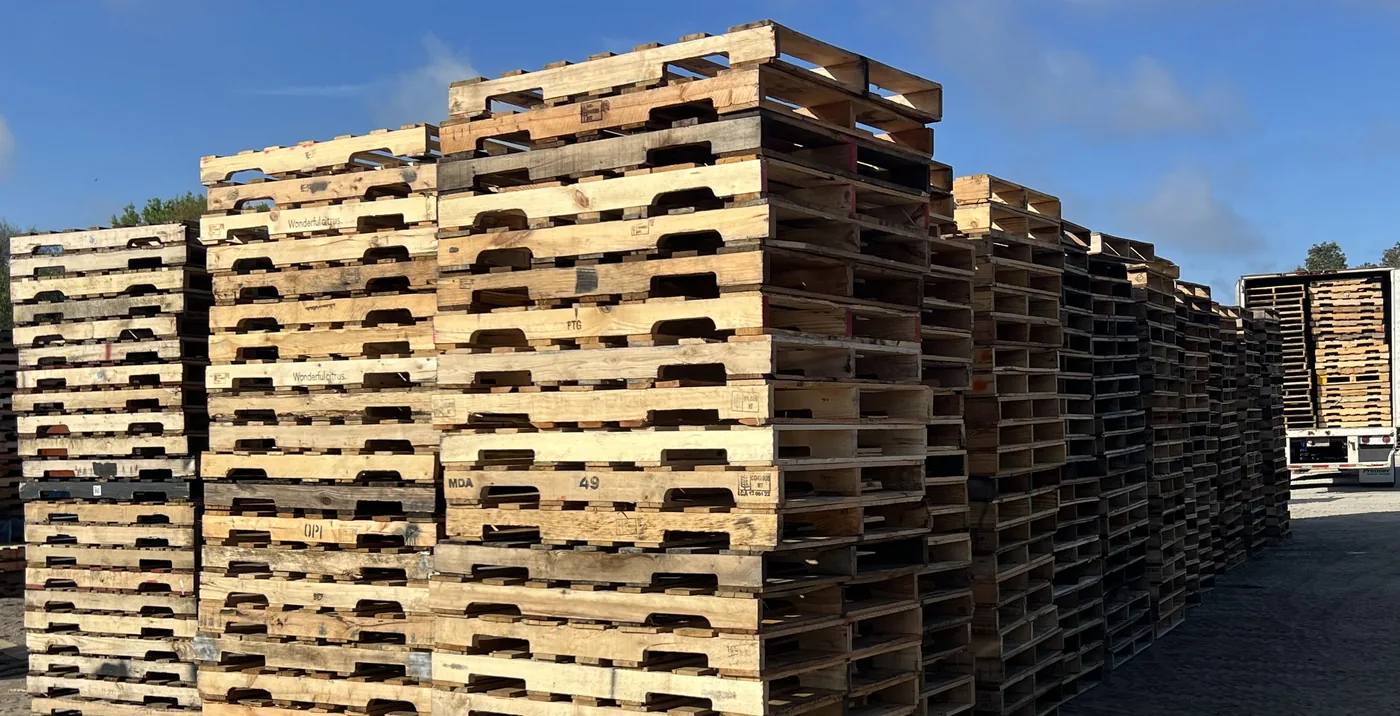
EUR/EPAL pallets are 1200 x 800 mm wood block pallets built to specifications maintained by the European Pallet Association (EPAL) under licensed production. Each pallet carries EPAL marks on its corner blocks, and the middle block carries the ISPM-15 mark and producer information. The design has nine blocks with three bottom boards running the long direction and allows four-way fork entry. The format traces back to the European railway pallet pool, and it is widely used in European grocery and consumer goods supply chains, often on an exchange basis.
How the 1200 x 800 mm format fits European logistics
The 1200 x 800 mm footprint is one of the six sizes listed in ISO 6780 and is matched to European trucks, racking and retail equipment. A commonly cited figure is 33 EUR pallets in a standard 13.6 m European semi-trailer. The related 1200 x 1000 mm size is also common in Europe for industrial goods. Neither fits US trailers and racks as efficiently as the 48 x 40 inch pallet, so mixing formats in a US warehouse usually needs separate rack positions or careful trailer planning.
What exporters and importers should know
- Only licensed producers and repairers may make or repair pallets carrying the EPAL mark. Look for clear marks on the blocks rather than accepting a lookalike 1200 x 800 mm pallet.
- EUR/EPAL pallets are often traded in an open exchange pool, where receivers return an equal number of pallets of comparable quality.
- For shipments into or out of Europe on wood pallets, ISPM-15 treatment and marking apply.
- If a European customer specifies EPAL, a generic 1200 x 800 mm pallet may be rejected, so confirm the requirement in writing.
Authoritative Sources
- Consumer Brands Association (formerly GMA) (CBA): the trade association whose 48x40 inch pallet standard (the "GMA pallet") became the dominant US pallet specification.
- International Organization for Standardization (ISO): the international standards organization that publishes ISO 6780 (flat pallets for intercontinental materials handling) and ISO 18613 (repair of flat wooden pallets).
Related Glossary Terms
Frequently Asked Questions
Is a EUR pallet the same as a 48 x 40 inch pallet?
No. A EUR pallet measures 1200 x 800 mm, which is about 47.2 x 31.5 inches, so it is narrower than a 48 x 40 inch pallet, which is about 1219 x 1016 mm. The construction also differs: EUR pallets are block pallets with four-way entry, while the common US GMA style pallet is a stringer pallet with partial four-way entry. Both sizes appear in ISO 6780, but they are not interchangeable in racks or trailers.
Can any manufacturer make an EPAL pallet?
No. The EPAL mark is a registered trademark, and only producers and repairers licensed by EPAL may make or repair pallets that carry it. Licensed producers are subject to quality inspection, and the marks on the blocks identify the pallet as a licensed product. Pallets of the same size without the marks can be perfectly usable, but they are not EPAL pallets and may not be accepted in exchange pools or by customers who specify EPAL.