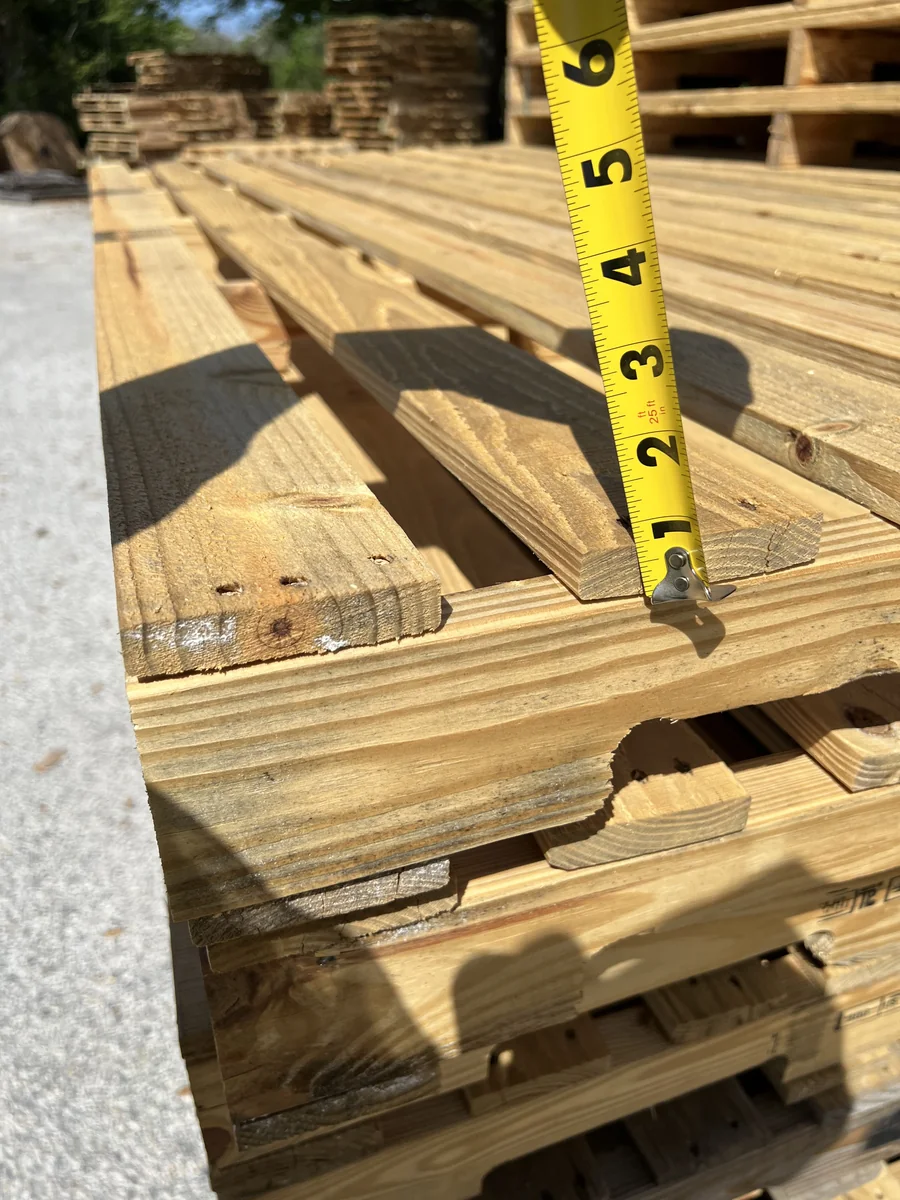
A pallet block placed at midpoint between corner blocks on a block pallet.
Detailed Definition
On a typical nine-block block pallet, the blocks sit in a three-by-three grid: four corner blocks, one center block and four mid blocks, one at the middle of each edge. The mid blocks carry load from the deck boards and stringer boards to the floor or rack, and the gaps on either side of them form the two fork openings on each face, which is what makes a block pallet fully four-way. Blocks may be solid wood, laminated wood or compressed wood composite, and they are nailed through the stringer boards above and the bottom boards below.
Why mid blocks matter for strength
Mid blocks support the middle of each edge, where the top deck and stringer boards would otherwise span the whole width of the pallet. Without them, the deck would flex more under load, and a pallet set on rack beams or conveyors would bend at the unsupported span. When a pallet is racked across its width, the mid blocks on the beam faces help carry the load directly onto the beam.
Mid block size also controls fork opening width. Wider blocks give more bearing area but narrower openings for forks and pallet jack wheels, so the dimensions are set by the pallet specification, such as the EUR/EPAL pallet or a pool's design.
Inspecting mid blocks
- Look for split or crushed blocks, often caused by forks striking the block instead of entering the opening.
- Check that the block is not twisted or loose, which shows failed nails.
- Check nails are not protruding, since that damages product and pallet jack wheels.
- On composite blocks, look for crumbling or delamination after wetting.
A damaged mid block weakens the whole edge. Repairers usually replace the block and re-nail the stringer board rather than adding a companion block, but check the customer's repair rules before accepting repaired pallets.
Related Glossary Terms
Frequently Asked Questions
How many blocks does a block pallet have?
The most common block pallet design uses nine blocks in a three-by-three grid: four corner blocks, four mid blocks at the middle of each edge, and one center block. Some designs, especially larger or heavy-duty pallets, use more blocks, and some light designs use fewer. The pallet specification or pool design sets the count, dimensions and material, so check it if you are buying or repairing block pallets.
What causes mid blocks to split, and how can it be prevented?
Mid blocks are most often damaged when forklift tines hit the block instead of the fork opening, or when pallets are pushed and dragged by the forks. Dry, brittle wood and nails driven too close to the block edge also make splits more likely. Training operators to square up and enter the opening fully, using pallets with correctly sized openings, and keeping fork tips in good condition all reduce block damage.