A double-faced pallet with identical top and bottom decks, allowing either side to be loaded.
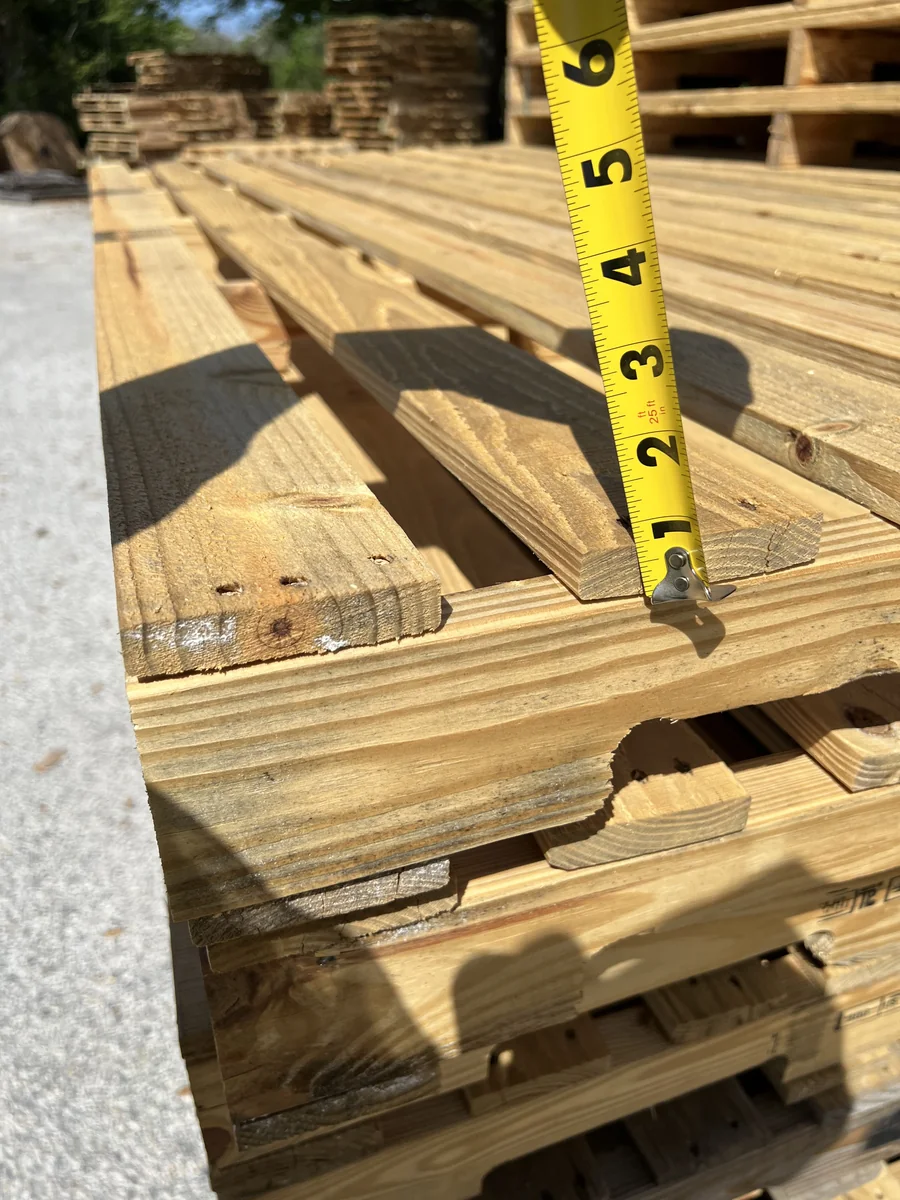
Detailed Definition
A reversible pallet is a double-faced pallet whose bottom deck is built the same as its top deck, with the same number, size and spacing of boards. Either face can carry the load, and the pallet works the same way up or down. Not every double-faced pallet is reversible: many have a bottom deck with fewer or narrower boards, which makes them non-reversible. Reversible designs are often used where pallets are stacked, conveyed or handled without anyone checking which side is up.
Reversible versus non-reversible
A typical 48 x 40 inch stringer pallet has more boards on top than on the bottom, so it must be used top side up. A reversible pallet repeats the top deck on the bottom. That adds wood and weight, but either side can be loaded and both decks share wear. A reversible pallet may still be two-way or four-way entry depending on the stringer or block design.
Where reversible pallets are used
- Automated systems and conveyors where the pallet may arrive either side up.
- Heavy loads where a full bottom deck spreads weight on the floor or in a rack.
- Stacking empty pallets in automated dispensers.
- Applications where one face can be kept for clean product and the other for handling.
What to specify
When ordering, state that both decks must match, and give the board count, width and thickness for each deck. Note whether the pallet is flush or has overhanging deck boards. Expect a reversible pallet to weigh noticeably more than a non-reversible pallet of the same size and lumber, which can affect freight and manual handling.
Related Glossary Terms
Frequently Asked Questions
Is a reversible pallet stronger than a non-reversible one?
Often, because the full bottom deck spreads load on the floor and in racks better than a sparse bottom deck. But strength also depends on stringer or block size, board thickness, lumber grade and fasteners. A well-designed non-reversible pallet can outperform a light reversible one. Compare rated capacities for the actual designs rather than assuming reversible means stronger.
How can I tell if a pallet is reversible?
Turn it over and compare the decks. If the bottom has the same number of boards, with the same widths, thicknesses and spacing as the top, it is reversible. If the bottom has fewer boards, narrower boards or wider gaps, it is a non-reversible double-faced pallet. A pallet with no bottom deck at all is single-faced.