A pallet with both top and bottom decks, providing better load distribution and stacking stability.
Detailed Definition
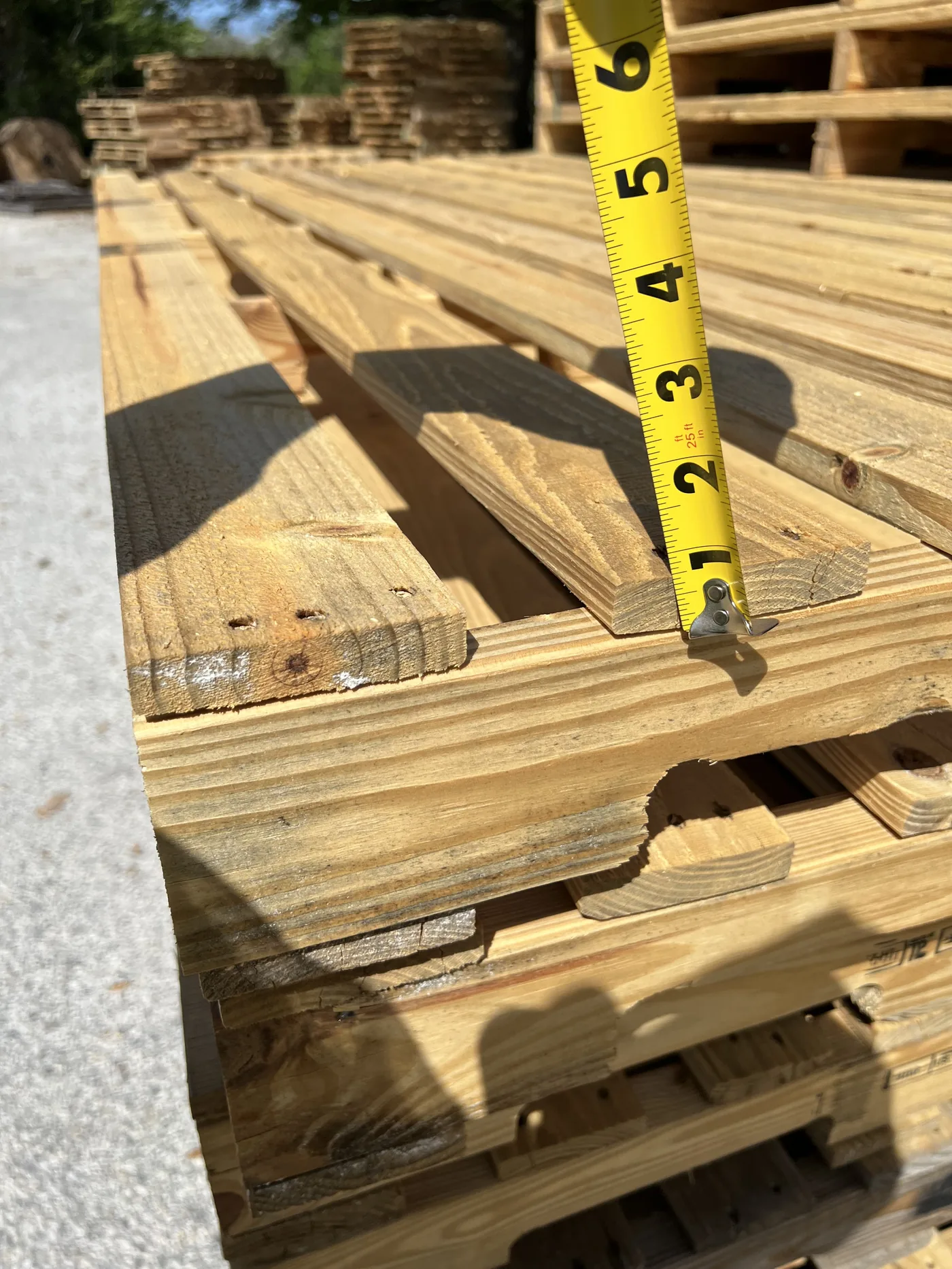
A double faced pallet has deck boards on both the top and the bottom, as opposed to a single faced pallet that has a top deck only. The bottom deck spreads the load onto the floor, onto conveyor rollers or onto the pallet below in a stack, and it ties the stringers or blocks together. Double faced pallets can be reversible, with identical top and bottom decks, or non-reversible, where the bottom deck has fewer or narrower boards. The common 48 x 40 inch GMA style pallet is a double faced, non-reversible design.
Reversible and non-reversible double faced pallets
On a reversible pallet the top and bottom decks are the same, so either face can carry the load. This is useful where pallets are flipped by a pallet inverter or used without regard to orientation. On a non-reversible pallet the bottom deck has fewer boards, which saves wood and weight and leaves room for pallet jack wheels to reach the floor. Most stringer pallets used in US grocery and retail are non-reversible.
Why the bottom deck matters
- Stacking: when loaded pallets are stacked, the bottom deck spreads weight across the load below instead of concentrating it on the stringer lines.
- Conveyors and automation: many roller conveyors and automated systems need continuous bottom boards running across the rollers.
- Racking: bottom boards help the pallet stay stable on rack beams and drive-in rails.
- Pallet jacks: bottom board layout must leave openings for the jack wheels, which is why some designs leave gaps or use chamfered boards.
When specifying a pallet, state the number, width and thickness of bottom boards, not just double faced, so that every supplier quotes the same design.
Related Glossary Terms
Frequently Asked Questions
Is a double faced pallet always stronger than a single faced pallet?
Not always in every direction, but a bottom deck generally improves stiffness, durability and how evenly the pallet carries load on the floor and in stacks. Capacity also depends on the stringers or blocks, board thickness, wood species, fasteners and how the pallet is supported. Rated capacity should come from design software or testing for the specific design and support condition, not from the face type alone.
Can a pallet jack handle a double faced pallet?
Yes, if the bottom deck is designed for it. A pallet jack needs its wheels to pass through openings in the bottom deck and reach the floor. Non-reversible pallets usually leave those openings, and chamfered bottom boards help the wheels roll over the edge. Fully reversible pallets with closely spaced bottom boards can be difficult or impossible to handle with a pallet jack, so check the handling equipment before choosing the design.