A pallet whose top deck boards extend beyond the outer stringers or blocks, while the bottom deck stays flush with them.
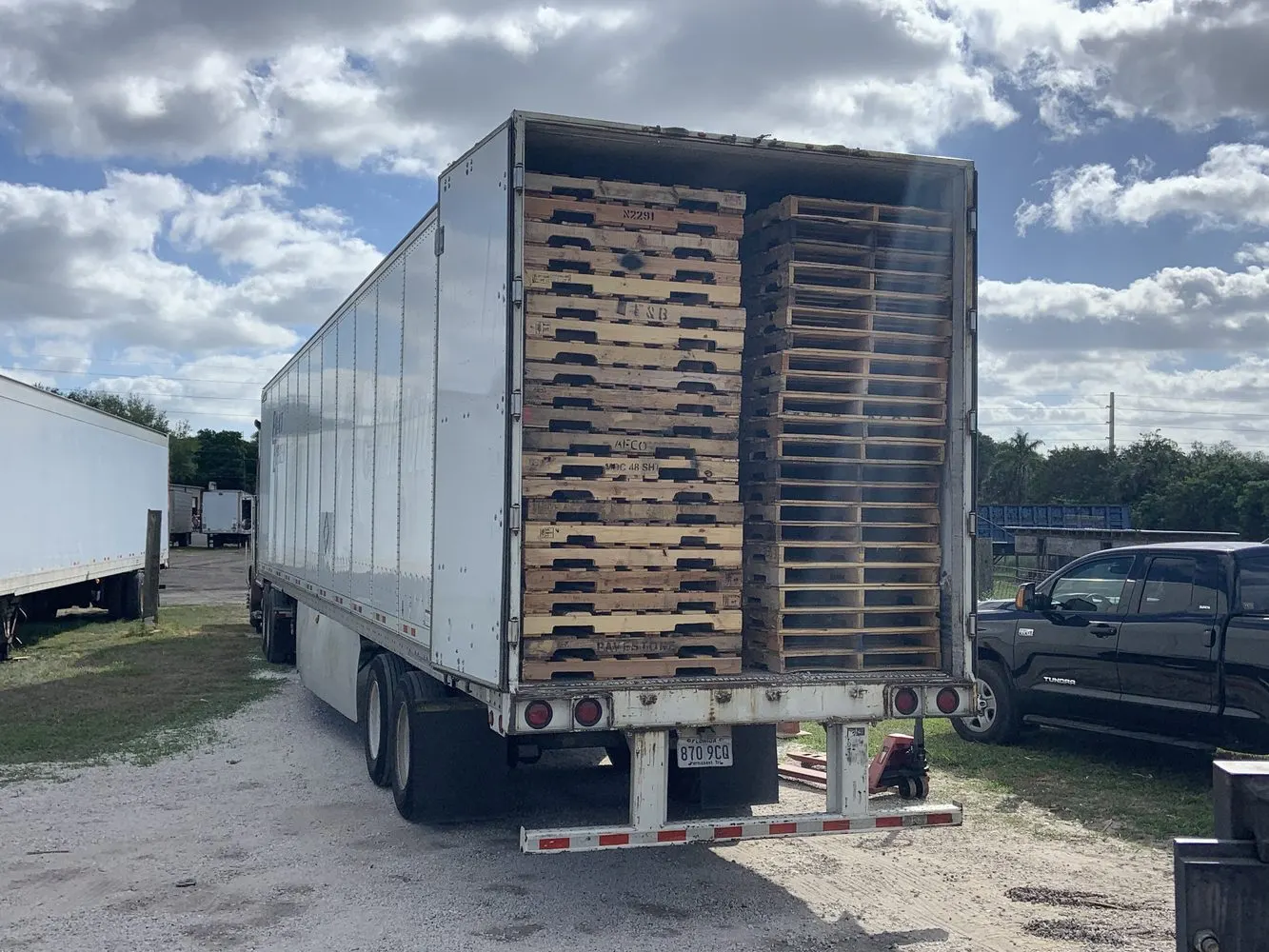
Detailed Definition
In a single wing pallet only the top deck overhangs the outer stringers; in a double wing pallet both decks overhang, and in a flush pallet neither does. The overhang leaves room for slings, straps or bar hooks to grip the underside of the top deck, so wing designs are used where loads are lifted by crane or hoist, and for some bagged or building products. The trade-off is that the unsupported board ends are more exposed to impact damage.
Wing vs flush construction
On a flush pallet the deck board ends line up with the outer face of the edge stringers, so the pallet is a clean rectangle. On a wing pallet the boards are cut longer than the stringer spacing, leaving a lip on each side. A single wing has the lip on the top deck only. The lip gives lifting gear something to catch, but it also means the overall pallet size is larger than the stringer frame.
Handling and storage considerations
The overhanging board ends are unsupported, so they can crack when struck by forks, trailer walls or other pallets. In racking, the wings add to the pallet's overall width or depth, which affects beam spacing and clearances between loads. Conveyors, pallet dispensers and automated systems are generally designed around flush pallets, so check with the equipment supplier before introducing wing pallets into automated lines.
Specifying a single wing pallet
- Overall length and width, including the overhang.
- Overhang per side, or the distance between outer stringers.
- Which deck overhangs.
- Board thickness, since thicker boards resist breaking at the wing.
Related Glossary Terms
Frequently Asked Questions
Why would I choose a wing pallet instead of a flush pallet?
Mainly for lifting with slings, bars or hooks. The overhanging top deck gives lifting gear a place to engage without passing under the whole pallet, which is useful for crane handling on construction sites, in ports, or for some bagged materials. If your loads only ever move by forklift or pallet jack and go into standard rack or automation, a flush pallet is usually the simpler and more durable choice.
How should I state the size of a single wing pallet?
Give the overall dimensions including the overhang, and also state either the overhang per side or the distance across the outer stringers. The two can differ by several inches, and suppliers may assume different conventions. Stating stringer length first, as is usual in the US, and confirming dimensions on a drawing avoids getting pallets that do not fit your rack, trailers or lifting gear.