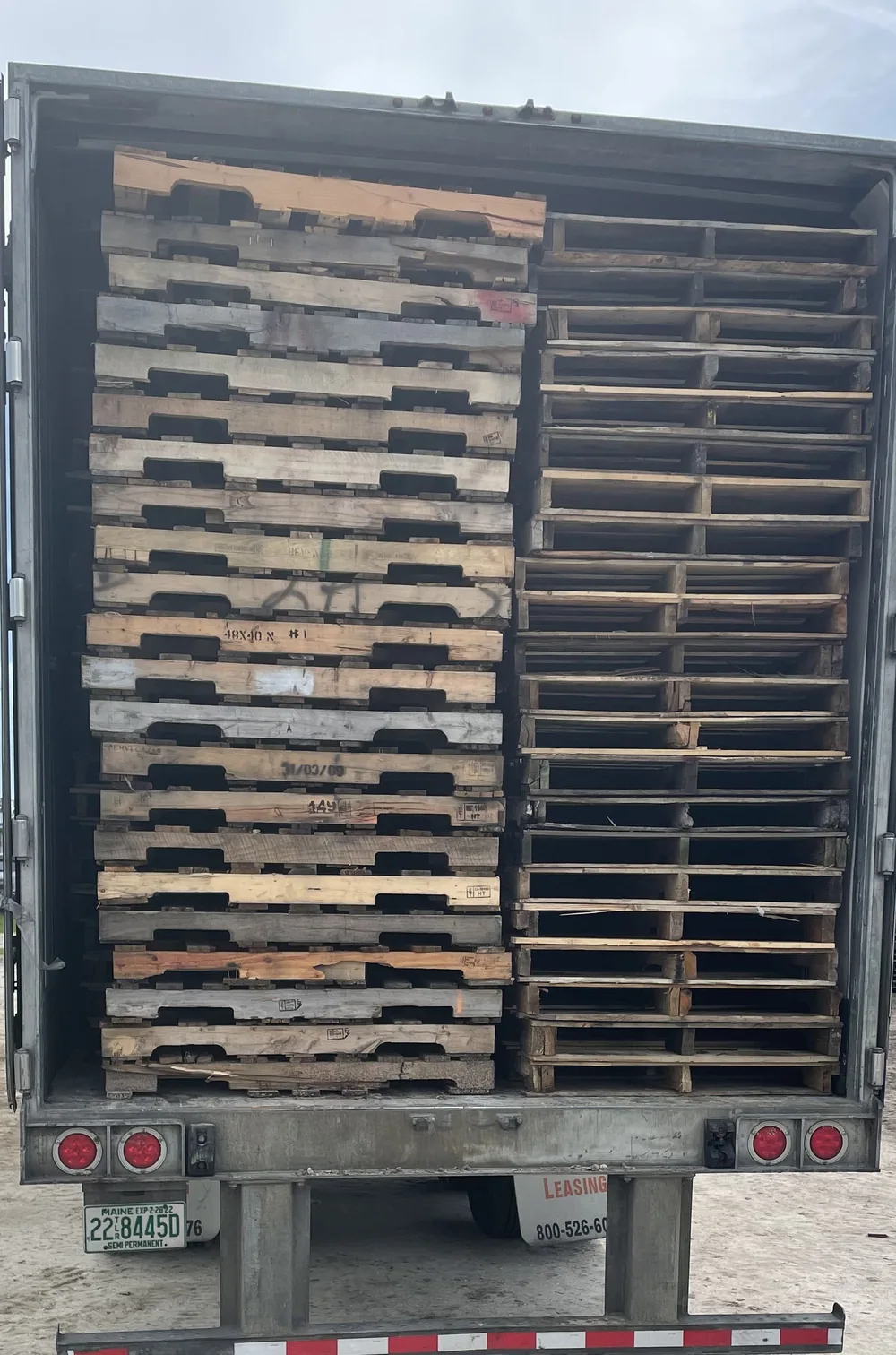
A pallet with deck boards extending past the stringers on both top and bottom decks.
Detailed Definition
On a wing pallet the deck boards overhang the outside stringers or blocks, creating a ledge or wing along the edges. A double wing pallet has this overhang on both the top and bottom decks, while a single wing pallet has it on the top deck only. Wings were traditionally used so that slings or bridle hooks could grip under the deck for crane or hoist handling, which is why the design is associated with sacked goods, building materials and port handling. It is the opposite of a flush pallet, where the deck ends line up with the stringers.
Why pallets are built with wings
The overhang gives lifting equipment something to catch. A sling, bar or hook placed under the wing can lift the pallet without forks, which was useful for ship holds and cranes. Wings can also give a slightly larger deck surface for bulky loads using the same stringer spacing. Because the outer stringers sit inboard of the deck edge, the overhanging board ends are unsupported, and their strength depends on board thickness and the length of the overhang.
Limitations buyers should know
- Overhanging board ends are more exposed to impact from forks, other pallets and walls, so they break more often than boards on a flush pallet.
- Many rack systems, conveyors and automated equipment are set up for flush pallets with the stringers at the edge and may not support wing pallets correctly.
- Pallet counts and dimensions must be measured to the outside of the deck, not the stringers, when planning trailer and rack space.
Before ordering, confirm the overhang dimension, which decks have wings, and whether the receiver's handling equipment accepts the design. A sample pallet sent ahead of the first order can settle these questions quickly.
Related Glossary Terms
Frequently Asked Questions
When should I choose a double wing pallet over a flush pallet?
A double wing pallet makes sense when loads are lifted by slings, bars or hooks under the deck, for example in some building material, bagged product or crane handled shipments. For most warehouse, retail and conveyor applications, a flush pallet is usually preferred because it handles more predictably on racks and automated equipment and the board ends are better protected. Confirm the handling method at both the shipping and receiving ends before choosing.
How do I measure the size of a wing pallet?
Measure the overall deck dimensions from board end to board end and from outside edge to outside edge, because that is the space the pallet occupies on a trailer or rack. Also record the stringer length and the overhang on each side. On a wing pallet, the stringer spacing and the deck size are not the same, so giving only one of them on a purchase order can lead to the wrong pallet.