Lumber dried by exposure to outdoor or ambient air, usually stacked with spacers, rather than in a kiln. Its final moisture content depends on climate, season and drying time.
Detailed Definition
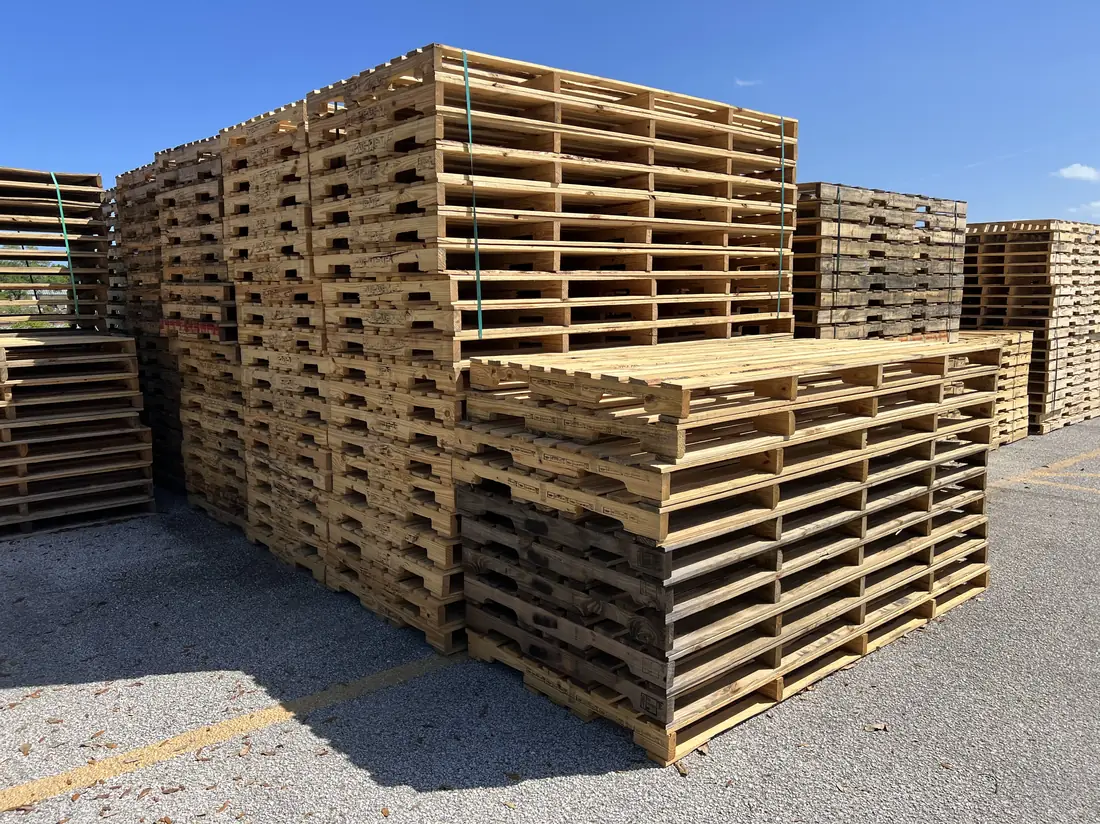
Air-dried lumber is stacked outdoors or in open sheds with thin spacers called stickers between layers so air can move through the pile. Over weeks or months the wood loses moisture until it approaches equilibrium with the surrounding air, so the final moisture content varies with region, season and species. Air drying is not a phytosanitary treatment and does not meet ISPM 15 for export pallets. Much pallet lumber is used green, so air-dried stock is an intermediate option.
Air-dried, kiln-dried and green compared
- Green lumber is used soon after sawing and still holds much of its water.
- Air-dried lumber has lost some moisture outdoors, but how much varies and is not controlled.
- Kiln-dried lumber is dried in a heated chamber to a target moisture content. For softwood dimension lumber, KD commonly means 19 percent or less.
A kiln can also run a heat treatment schedule for ISPM 15, but drying and heat treatment are separate requirements.
What air drying means for pallet buyers
Drier wood weighs less, shrinks less after assembly and is less prone to mold, which matters for food, pharmaceutical and export shipments. However, air-dried lumber can regain moisture in wet weather, and the outer boards in a pile may be drier than the inner ones. If moisture matters, ask the supplier to measure it with a moisture meter at delivery, and state a maximum value on the purchase order. Expect some nail loosening as any wood used above its service moisture continues to dry.
Mold and stain risk
Slow drying in warm, humid weather gives mold and sapstain fungi time to grow on the surface, especially on sapwood. Good sticker spacing, airflow and covered piles reduce the risk. Visible mold on pallets is a common reason for rejection by food and pharmaceutical receivers.
Related Glossary Terms
Frequently Asked Questions
Is air-dried lumber good enough for export pallets?
Not on its own. ISPM 15 requires an approved treatment such as heat treatment to a core temperature of at least 56 C for 30 continuous minutes, followed by the official mark. Air drying does not reach or document that temperature. Air-dried lumber can be used if the finished pallets or lumber are then heat treated by an accredited facility and marked.
Why does my pallet supplier not offer air-dried pallets?
Air drying takes yard space and time, and the result is not controlled or easily documented. Many pallet mills build with green lumber for cost and speed, and use kilns when a customer needs drier wood or heat treatment. If you need lower moisture, specifying kiln-dried or heat-treated lumber with a maximum moisture content is usually more reliable.