An open trailer without sides or roof, used for oversized, heavy, or awkward loads.
Detailed Definition
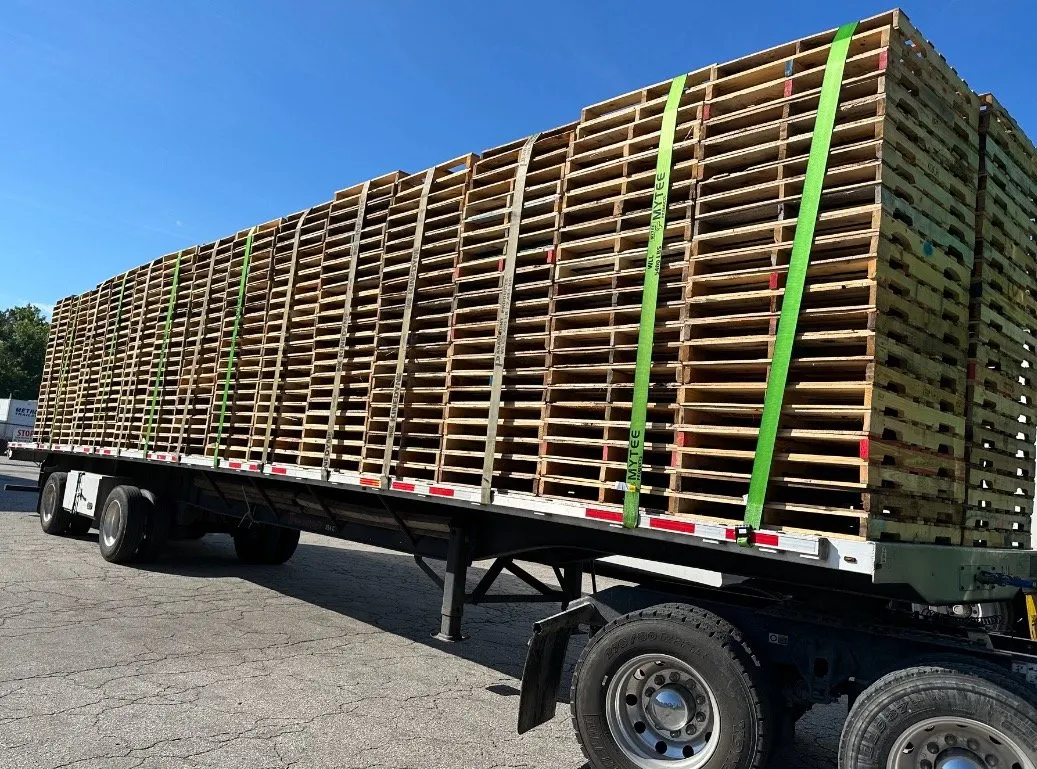
A flatbed is an open deck trailer with no walls or roof, so it can be loaded from the sides, the top or the rear. Common lengths are 48 and 53 feet. Because nothing encloses the freight, every load must be secured with straps, chains or other tie-downs under the federal cargo securement rules in 49 CFR Part 393, and many loads are tarped against weather. Variants such as the step deck and lowboy lower the deck for taller loads.
When palletized freight rides on a flatbed
Most pallet freight moves in a dry van, but a flatbed makes sense when product is too tall, too wide or too heavy for a van, or must be loaded by crane or from the side. Building materials, lumber, pipe, machinery and stacks of new pallets are typical examples. Side loading also helps at sites without a dock, since a forklift can reach the deck from the ground.
Securing and protecting pallets on an open deck
Pallets on a flatbed are exposed to wind, rain and road spray for the whole trip, and strap tension presses down on the load. Practical checks before loading:
- Unitize each pallet tightly with stretch wrap or strapping.
- Use edge protectors where straps cross the load so they do not crush cartons.
- Ask whether the carrier will tarp the load and whether tarping costs extra.
- Confirm the pallets and product can take strap pressure without crushing.
- Keep loads within the legal height for the route, especially when stacking.
Flatbed versus step deck and lowboy
A standard flatbed has a single flat deck. A step deck drops part of the deck lower so taller freight stays under height limits, and a lowboy drops it further for heavy machinery. Choose the trailer by the tallest and heaviest piece, then confirm loading equipment at both ends can reach the deck.
Related Glossary Terms
Frequently Asked Questions
Is a flatbed cheaper than a dry van for pallet freight?
Not usually. Flatbed rates depend on equipment availability, region, season and the extra work of securing and tarping, so they can run higher or lower than van rates. For standard pallets that fit in a van, a dry van is normally the simpler choice because the load is enclosed and easier to protect. A flatbed earns its place when the freight's size, weight or loading method rules out a van. Get quotes on both when either could work.
Can pallets be stacked on a flatbed?
Sometimes, if the product and pallets can carry the weight and the stack stays stable under strap pressure. Stacking raises the center of gravity, makes securement harder and must stay within legal height limits for the route. Bundles of empty pallets are often stacked and banded on flatbeds. For finished goods, check the product's stacking limits and agree the securement plan with the carrier before the truck arrives.