Lumber grading classifies wood by defects, strength, and appearance for pallet construction.
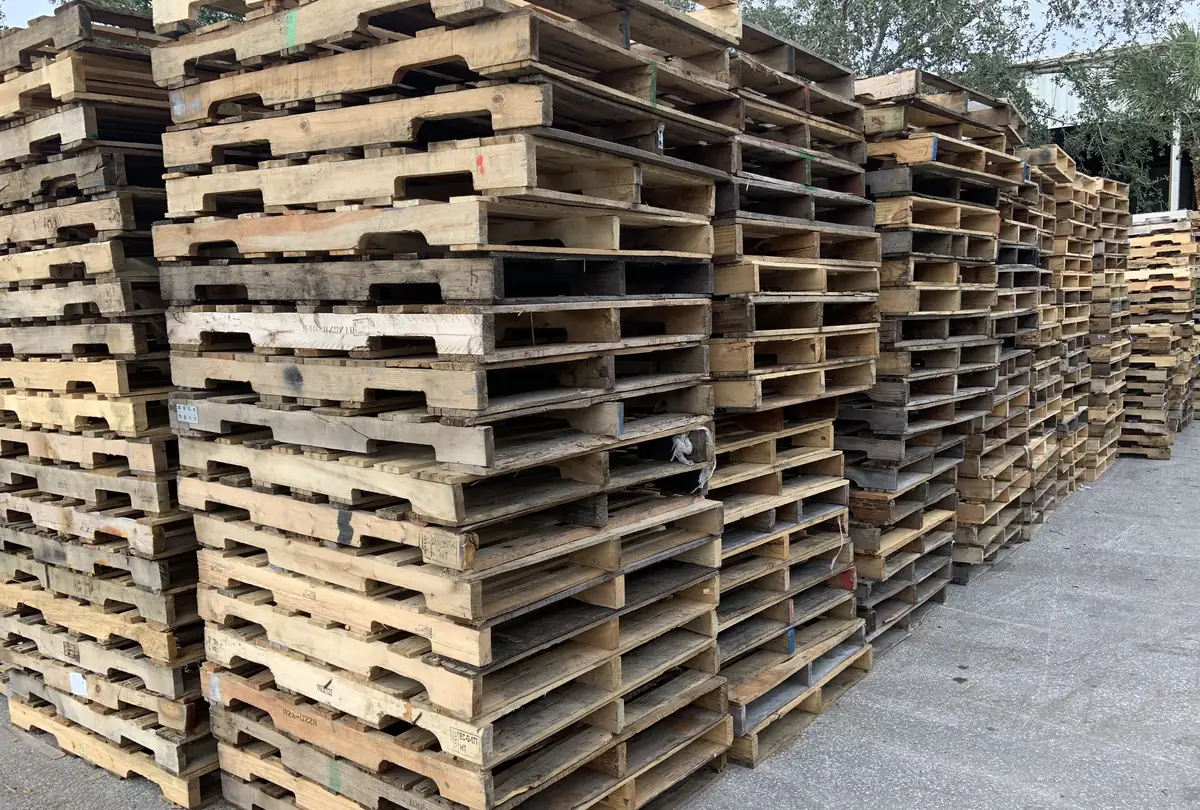
Detailed Definition
In the US, softwood lumber grading rules are written by agencies such as SPIB, WWPA, NeLMA and WCLIB, and the American Lumber Standard Committee (ALSC) approves the rules and accredits the agencies under voluntary product standard PS 20. Common softwood grades include No. 1, No. 2 and No. 3. Hardwood lumber uses a different system based on clear cuttings, written by the National Hardwood Lumber Association. Much pallet lumber is not grade stamped at all and is instead bought to a pallet specification that sets defect limits.
Reading a softwood grade stamp
A grade stamp on graded softwood typically shows the agency mark, the mill number, the grade, the species or species group, and the moisture condition at surfacing, such as S-GRN for green or S-DRY or KD19 for lumber dried to 19 percent moisture or less. If a pallet specification calls for graded lumber, ask the supplier which grade and species they use and whether the wood was stamped at the mill.
How grade relates to pallet performance
Grades are set mainly by the size, number and location of knots, plus slope of grain, wane, splits and decay. Higher grades have fewer strength-reducing defects. For a pallet, a large knot near the middle of a deck board or a cross-grain stringer can be a weak point, regardless of species.
- Specify maximum knot size and location for critical parts such as stringers.
- Specify minimum thickness and width after manufacture.
- Prohibit decay and through splits at nail locations.
Engineered pallet designs often assume a lumber quality level, so if the supplier changes the lumber source, the rated capacity may no longer hold. Ask for the design assumptions when capacity matters.
Authoritative Sources
- American Lumber Standard Committee (ALSC): the committee that accredits lumber grading agencies under the US Department of Commerce voluntary product standard PS 20.
- Pacific Lumber Inspection Bureau (PLIB): the lumber grading agency accredited by the American Lumber Standard Committee for Pacific softwoods used in pallet production.
- Southern Pine Inspection Bureau (SPIB): the lumber grading authority for Southern Yellow Pine, the most common pallet stock in the US Southeast.
- US Forest Service (USFS): the federal agency that manages the National Forest System and reports on US lumber supply used in pallet production.
Related Glossary Terms
Frequently Asked Questions
Do pallets need to be built from grade-stamped lumber?
Generally no. Most standard pallets are built from pallet stock bought to the pallet maker's or customer's own specification, which limits defects and sets dimensions without requiring a grade stamp. Graded lumber is more likely to be specified where a customer wants engineered, documented capacity or for crates and structural packaging. If your application needs it, write the grade, species and moisture condition into the purchase specification.
What is the difference between softwood and hardwood lumber grades?
Softwood grades such as No. 1, No. 2 and No. 3 are mainly about strength for structural use and are written by ALSC-approved agencies. Hardwood grades such as FAS, No. 1 Common and No. 2 Common, written by the National Hardwood Lumber Association, are based on the share of clear, defect-free pieces that can be cut from a board for furniture and millwork. Pallet hardwood is usually low-grade material not sold under these appearance grades.