A lumber mill processes raw timber into dimensional lumber for pallet manufacturing.
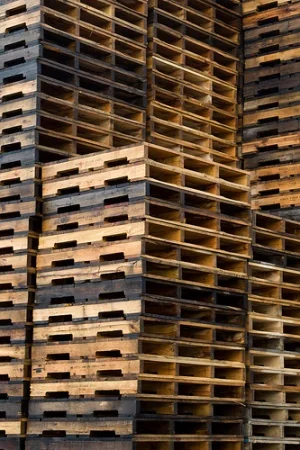
Detailed Definition
A lumber mill, or sawmill, saws logs into boards, timbers and cants. Some mills sell graded dimension lumber; others, especially hardwood mills, sell cants and low-grade boards that pallet makers resaw into deck boards and stringers. Softwood mills that sell graded lumber subscribe to an agency such as SPIB or PLIB whose rules are approved by the ALSC. Some pallet companies run their own sawmills, called pallet mills, that cut pallet parts directly from logs.
From log to pallet parts
A typical mill debarks logs, saws them into cants and boards, trims to length, and sorts the output. The highest-value boards from a hardwood log go to furniture, flooring and millwork markets, while the center cant and lower-grade pieces often go to pallets and crossties. This is one reason pallet lumber supply is tied to the wider lumber market.
After sawing, lumber may be sold green, air-dried, or kiln dried. Mills that are certified for ISPM 15 heat treatment can also treat and mark wood packaging, but heat treatment and kiln drying are different processes with different goals.
What to check when sourcing from a mill
- Species and species mix, and whether it stays consistent between loads.
- Thickness and width tolerances on cut parts.
- Moisture condition at shipment.
- Whether the wood is debarked to ISPM 15 requirements if it is going into export packaging.
- Grade stamps or a written grade statement if graded lumber is required.
- Chain-of-custody certification, such as FSC or SFI, if your customer requires certified wood.
Visit or audit the mill if volumes are large, and agree in writing how out-of-spec loads are handled.
Authoritative Sources
- Pacific Lumber Inspection Bureau (PLIB): the lumber grading agency accredited by the American Lumber Standard Committee for Pacific softwoods used in pallet production.
- Southern Pine Inspection Bureau (SPIB): the lumber grading authority for Southern Yellow Pine, the most common pallet stock in the US Southeast.
- US Forest Service (USFS): the federal agency that manages the National Forest System and reports on US lumber supply used in pallet production.
Related Glossary Terms
Frequently Asked Questions
What is a cant and why do pallet makers buy them?
A cant is a large squared timber cut from the center of a log after the outer boards are removed. In hardwood sawmilling, the center often contains more knots and defects, so it is less valuable for furniture lumber. Pallet makers buy cants and resaw them into stringers and deck boards, which turns lower-value wood into a useful product and keeps pallet material costs down.
Does a sawmill decide the grade of the lumber?
For graded softwood lumber, mill graders apply the grading rules of an ALSC-accredited agency, and the agency inspects the mill to check that grading is being done correctly. The grade stamp identifies both the agency and the mill. For ungraded pallet stock, there is no third-party grade; the mill and buyer agree on a written specification instead, and the buyer should inspect incoming loads against it.