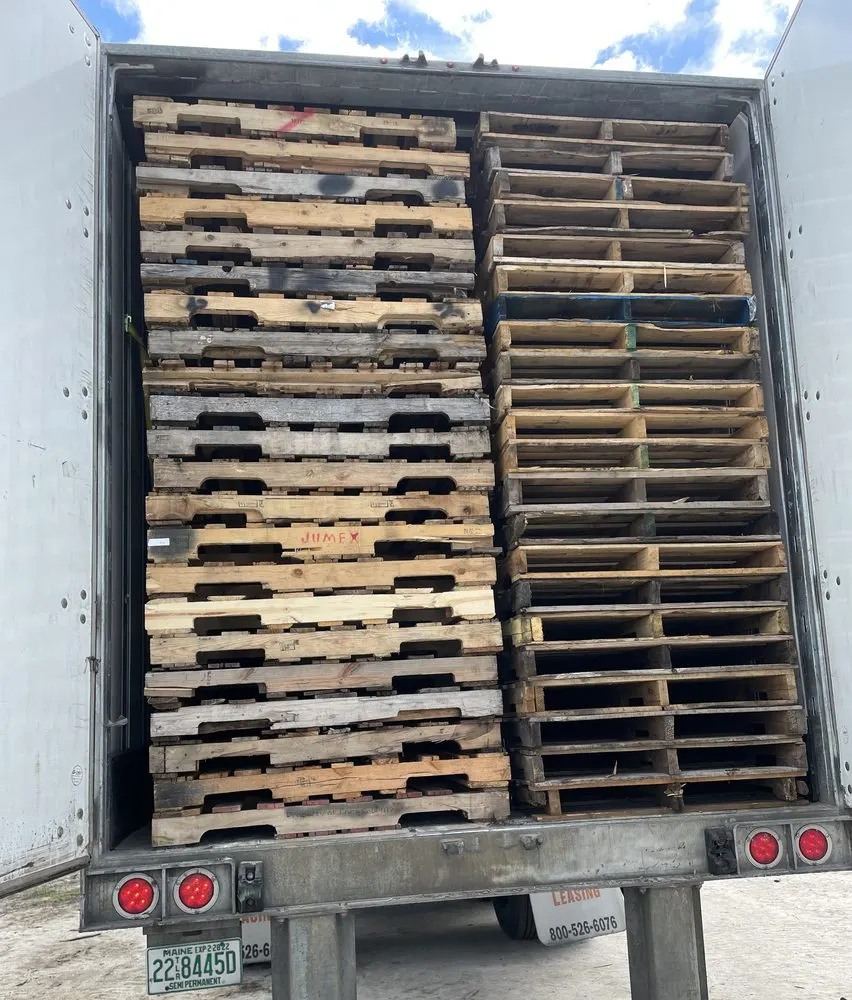
A recycled pallet is a previously used wood pallet sorted, repaired if needed, and resold.
Detailed Definition
Recycled pallets come from distribution centers, retailers and manufacturers that collect empty pallets. Recyclers sort them by size and condition, repair those that can be fixed by replacing broken boards or reinforcing stringers, and resell them. Units that cannot be repaired are dismantled for parts or ground for mulch and fuel. Sellers usually describe condition as Grade A or Grade B, sometimes Grade C. These are trade terms, not a national standard, so their meaning varies by supplier.
How a recycled pallet is processed
Incoming pallets are unloaded and sorted by footprint, design and condition. Pallets in good shape may only need nails driven in or loose boards fixed. Damaged ones are repaired by replacing deck boards or adding a companion stringer next to a cracked one. Some recyclers also build remanufactured pallets from salvaged boards. Pool pallets, such as CHEP and PECO, are not supposed to enter this stream and should be returned to their owners.
How to buy recycled pallets
- Ask the supplier to describe each grade in writing: allowed repairs, board condition, stains and protruding nails.
- Request sample pallets before a large order.
- Confirm the design: stringer or block, two-way or four-way entry, and the number of deck boards.
- For export, confirm the pallets were heat treated and marked after any repair, following ISPM 15 rules for repaired units.
- For food or pharma, state cleanliness and moisture requirements.
Recycled versus new pallets
Recycled pallets usually cost less than a new pallet of the same size and keep wood in use longer, which ranks reuse above recycling and disposal in the EPA's waste management hierarchy. The trade-off is less uniformity: boards, weights and appearance vary from pallet to pallet.
Authoritative Sources
- National Wooden Pallet & Container Association (NWPCA): the US trade association representing wood pallet manufacturers, recyclers, and component producers, founded in 1947.
- US Environmental Protection Agency (EPA): the federal environmental agency; this page describes its non-hazardous materials and waste management hierarchy, which ranks source reduction and reuse above recycling, energy recovery and disposal.
Related Glossary Terms
Frequently Asked Questions
Are recycled pallets strong enough for heavy loads?
Many are, but strength varies more than with new pallets because boards may have been replaced and the original design may be unknown. For heavy or racked loads, specify the design, board thickness and grade, and test a sample under real conditions. If a load needs a documented rated capacity, a new pallet built to a known design is usually the safer choice.
Can recycled pallets be used for export?
Yes, if they meet ISPM 15. A used pallet needs the IPPC mark for an approved treatment. Under ISPM 15, a repaired or remanufactured pallet may need to be treated again and remarked, depending on how much was replaced and whether the new wood was already treated. Ask the supplier how repaired export pallets are handled and confirm the mark is legible on two opposite sides.